

 BACK
BACK
Good Vibrations
in Vol. 26 - March Issue - Year 2025
Mass Finishing – A Key Technology for Surface Refinement of Aircraft Components

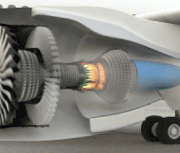
All airfoils must have a very smooth surface to minimize friction and optimize airflow in the engine
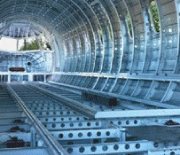
Before being assembled, numerous fuselage and wing components must undergo deburring and surface smoothing
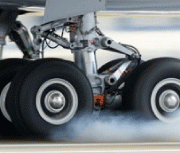
Compared to manual deburring—such as for landing gear struts—mass finishing produces much more consistent results and reduces cycle time by more than 90%
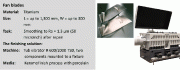
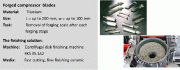
Engine Parts

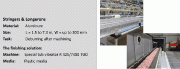
Fuselage
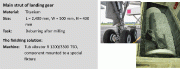
Landing Gear
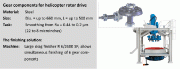
Other Components
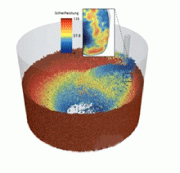
The digitization of finishing processes ensures maximum process stability and high-quality finishing results. It also generates a graphical display of the processes
Nearly all components used to build an airplane must have a first-class surface finish for various reasons. An excellent surface finish is essential for achieving maximum operational safety in an airplane. Equally important is the surface finish of engine components to ensure optimum performance of the aircraft engines, along with lower noise emissions. Last but not least, good surface finishes also help minimize the operational costs of an airplane by extending a component’s fatigue life. Shot blasting, including shot peening, is a crucial surface treatment method for a broad spectrum of aircraft components. However, mass finishing technology is no doubt equally important. Frequently, these two surface treatment systems go hand in hand to create an optimal surface finish on the same component.
Stringent Demands for Aircraft Safety, Engine Performance, and Cost Efficiency
For good reasons, the quality standards in the aerospace industry are extremely strict. For example, to guarantee maximum operational safety, no other industry demands a higher degree of component reliability. This ensures that today, the chance of getting hit by lightning is about 1,000 times higher than dying in an airplane crash.
When it comes to engine performance, all engine manufacturers strive to minimize the so-called “TSFC”—short for Thrust Specific Fuel Consumption. This is achieved by minimizing friction in the various engine components to reduce flow resistance and, thus, improve fuel efficiency.
Finally, to keep operational costs as low as possible, airplane manufacturers aim to extend the service life (fatigue life) of components and minimize their weight to reduce fuel consumption.
The Aerospace Surface Finishing Standards Are the Strictest in Any Industry
Among other factors, the surface finish of numerous aircraft components plays a key role in ensuring maximum operational safety, optimum engine performance, and high operational cost-efficiency. The strict aerospace quality standards, therefore, apply to practically all surface finishing tasks.
This is why—before a surface treatment process can be implemented—whether it involves simple surface cleaning and deburring, defined edge radiusing, surface smoothing, or polishing, the process must be approved and carefully documented. Once approved, the entire finishing operation must fully comply with the specified procedure, with no deviations allowed.
This applies not only to the actual process parameters but also to the finishing equipment and consumables used in the process. In the case of mass finishing, this includes the grinding and polishing media as well as the chemical additives.
These standards apply not only to the surface treatment of newly manufactured components but also to MRO operations—the repair and overhaul of used components.
Mass Finishing: A Highly Versatile Surface Refinement Technology
The spectrum of mass finishing applications in the aerospace industry is nearly endless—whether for engine parts, structural components for the fuselage and wings, landing gear, or many other components.
Mass finishing is an excellent tool for deburring blisks and compressor blades after milling. Smoothing and polishing of all kinds of airfoils—such as after shot peening—is especially important for optimal airflow in the engine. Mass finishing is equally effective for defined edge radiusing of the dovetail slots on turbine disks and deburring structural airplane components like stringers and longerons.
From the Smallest Workpieces to Very Large and Heavy Components
Mass finishing can handle a wide variety of workpieces, from very small parts weighing just a few hundred grams to very large and heavy components weighing several hundred kilograms.
For example, engine parts may include all kinds of fan, compressor, and turbine blades, blisks, vanes, turbine disks, and small engine casings.
Fuselage and wing components with lengths of up to 8 meters—including stringers, longerons, wing spars, ribs, and other large structural components—can be finished in dedicated mass finishing equipment.
The same applies to landing gear components such as struts, all kinds of linkages, wheels, and brakes.
In addition, other aircraft parts—such as seat and galley components, hydraulic parts, gears, fasteners, and even propellers for turboprop airplanes—must undergo a deburring, edge radiusing, or polishing operation.
In recent years, the production of airplane parts by additive manufacturing has seen rapid growth. When coming from the printer, the surface of 3D-printed parts is inherently rough. Mass finishing has become the dominant technology for smoothing and polishing the surface of such components.
Absolutely Repeatable, Consistent Surface Finishes at Amazingly Low Costs
Surprisingly, numerous finishing tasks in the aerospace industry are still performed by hand. Manual operations often produce inconsistent, low-quality surface finishes, resulting not only in extensive rework but also in a high scrap rate.
Mass finishing completely eliminates the human factor and consistently delivers precise, high-quality surface finishes. Once a suitable process has been established, it ensures absolutely repeatable finishing results, day in and day out.
Mass finishing is also remarkably fast, with short cycle times. Among the available surface treatment technologies, mass finishing is by far the most economical.
Above all, mass finishing is eco-friendly—it does not use dangerous chemicals and produces no hazardous waste!
Some Aerospace Finishing Applications in Detail
Please refer to the following chart:
- Engine Parts
- Fuselage
- Landing Gear
- Other Components
Process Digitization Guarantees Maximum Process Stability and Quality
To date, even though finishing processes in the aerospace and other industries may be carefully documented, they have largely depended on the qualification and expertise of the people developing and running them. A slight human error or oversight could disrupt a finishing process and result in costly consequences.
In recent years, the quality management of finishing operations has largely been transferred to digital tools. Instead of humans evaluating a finishing process, strategically placed sensors monitor the operating parameters and report them to a computer programmed with specialized algorithms. These algorithms analyze the sensor readings and, if the parameters deviate from the optimal range, recommend specific corrective actions. In some cases, corrective actions are undertaken fully automatically by the digital system.
This digitization, combined with sophisticated mechanical accessories—such as automatic media replenishment systems—guarantees absolute process stability and ensures high-quality, consistent results in the long term.
Of course, the digital system also provides a comprehensive operational logbook by recording the actual operating parameters of every finishing process.
Contributing Editor MFN and
Rösler Oberflächentechnik GmbH
Email: holzknecht.usa@gmail.com