
E-Archive

 BACK
BACK
Interview
in Vol. 27 - January Issue - Year 2026
Deep Rolling in Aerospace: Extending Component Life and Reducing CO2 Through Surface Engineering

Oliver Maiß, Head of Research and Development and Marketing at ECOROLL AG Werkzeugtechnik
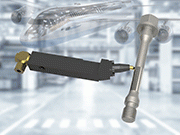
Stretch bolt
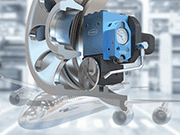
Deep rolling of an aircraft wheel hub
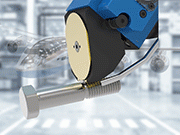
Deep rolling of a high-strength bolt
MFN had the pleasure of speaking with Dr.-Ing. Oliver Maiß, Head of Research and Development and Marketing at ECOROLL AG Werkzeugtechnik.
(?) MFN: Good afternoon, Dr. Maiß. Thank you for joining us again for another conversation. This time we’d like to talk about how surface strengthening processes such as roller burnishing and deep rolling can help the aerospace industry meet its demanding safety and sustainability targets.
(!) O. M.: Good afternoon, and thank you for the invitation. Yes, aerospace is a very exciting field for us at ECOROLL. It’s where the benefits of mechanical surface treatments really come together — high-performance materials, extreme fatigue requirements, and the constant drive for lighter, more efficient structures.
(?) MFN: Recently, ECOROLL supported a project in which titanium bolts for aircraft engines were roller burnished. Could you tell us what that was about?
(!) O. M.: The case study involved stretch bolts that are used to connect critical components such as engine housings. These bolts are exposed to severe cyclic loads and temperature fluctuations. Traditionally, they are made of high-strength titanium alloys, which are both lightweight and corrosion-resistant but also very sensitive to surface imperfections.
In this project, we applied our roller burnishing technology using an HG6-9 hydrostatic tool. Within just 28 seconds per bolt, we introduced compressive residual stresses into the subsurface layer. The results were impressive: 100% of the parts reached the required fatigue strength, manufacturing costs were reduced by 25%, and production speed increased by 30% compared with conventional processes.
(?) MFN: That’s quite remarkable. What makes roller burnishing so effective for components like these?
(!) O. M.: Essentially, it’s about the mechanical modification of the surface and subsurface. When we apply pressure with a burnishing ball or roller, we plastically deform the surface peaks and introduce compressive residual stresses underneath. These stresses counteract the tensile stresses that normally drive crack initiation.
As a result, small surface defects lose their harmful effect, and the component can endure many more load cycles before any damage occurs. Especially in areas with notches or geometric transitions — where stress concentrations are highest — this residual stress effect can double the fatigue life. And that’s exactly what we also see in our laboratory tests and in independent university studies.
(?) MFN: You mentioned studies. There has been research in Dresden and Chemnitz on how these residual stresses are accounted for in design guidelines. What was discovered there?
(!) O. M.: A team at TU Dresden and TU Chemnitz has examined how well existing design codes — such as DIN 743, FKM, and the newer FVA guideline — can predict the real fatigue behaviour of roller-burnished parts.
Their findings were particularly relevant: while these guidelines already include correction factors for surface conditions, the influence of residual stresses is still treated very conservatively. In practice, designers often use a factor close to 1, which means the potential benefit of roller burnishing or shot peening is hardly reflected in the calculation.
The researchers tested various notched specimens and found that roller burnishing could increase the fatigue limit by up to 94% for sharp notches under bending loads — nearly a doubling of strength. So, the real effect is much greater than what most design rules currently assume.
(?) MFN: In other words, the technology is ahead of the standard?
(!) O. M.: Exactly. Mechanical surface treatment methods have evolved faster than the standardisation. For many years, the processes were mainly justified by experience — engineers simply knew that burnished parts lasted longer. Now, we have the data and models to prove it.
If these effects are properly integrated into design guidelines, engineers can safely reduce material use without compromising safety. That means lighter components, lower raw material demand, and ultimately a smaller carbon footprint.
(?) MFN: Speaking of carbon footprint — in our previous interview you mentioned ECOROLL’s initiative to quantify CO2 savings through mechanical surface treatment. Is this aerospace case part of that picture?
(!) O. M.: Yes, definitely. Every time we extend the life of a component or reduce its weight while maintaining the same reliability, we contribute to sustainability. In aerospace, the impact is particularly strong: every kilogram saved can reduce tons of fuel consumption and emissions over the lifetime of an aircraft.
When we replace more energy-intensive processes like shot peening with integrated roller burnishing, we also reduce energy consumption during production. So, the effect is twofold — less CO2 in manufacturing and less CO2 in operation.
(?) MFN: It sounds like roller burnishing combines technical performance with environmental responsibility. Do you see this becoming a broader trend?
(!) O. M.: Absolutely. The pressure for lightweight design and resource efficiency is increasing across industries. Aerospace is often the pioneer, but the automotive and energy sectors are following right behind.
Our goal as a technology provider is to give engineers reliable, data-based tools so that sustainability and safety go hand in hand. Roller burnishing is a perfect example of how a mature mechanical process can still have transformative impact when applied intelligently.
(?) MFN: Thank you very much for this insight, Dr. Maiß. It’s fascinating to see how surface engineering can influence both performance and climate impact. We wish you and your team continued success.
(!) O. M.: Thank you. It’s been a pleasure to share our work with you again.
MFN would like to thank Oliver Maiß for this interview!
For Information:
ECOROLL AG Werkzeugtechnik
H.-H.-Warnke-Str. 8, 29227 Celle, Germany
Tel. +49.5141.9865-0
E-mail: oliver.maiss@ecoroll.de
www.ecoroll.de