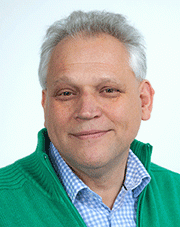
Recently, European manufacturing industries are faced with serious challenges: the tariff policy of the United States has not only disrupted established supply chains, but it has also made business in the United States, a historically large market for European products, extremely difficult. Moreover, Europe is faced with a flood of low-cost imports from China, including electric cars, solar panels, machine tools, as well as all kinds of industrial products and consumer goods. This has resulted in the loss of numerous manufacturing jobs. How are businesses coping with such difficult market conditions? MFN had the opportunity to talk with Rüdiger Böhm, head of global research and development at Rösler Oberflächentechnik GmbH, a leading supplier of surface refinement technologies in the fields of mass finishing, shot blasting, and post processing of 3D printed components. Of course, we were very interested to find out how Rösler is dealing with these business challenges.
(?) MFN: Rüdiger, we assume that Rösler, like many other globally operating manufacturing companies, is facing a somewhat difficult market environment, not only in Europe but all over the world?
(!) R. B.: During its nearly 100-year-old history, our company has faced numerous adverse market situations. I remember when in the late 1960’s mechanical typewriters were rapidly replaced by electric typewriters. Mechanical typewriters contain a lot of stamped metal components, so-called “type bars”, which must undergo a deburring/edge radiusing operation before being installed. Suddenly, these components were replaced by a single plastic “type ball”. Practically overnight, because of this remarkable technological innovation, we lost a fairly large chunk of our market. But we were able to quickly offset this loss with new opportunities in other industries.
This time things are different: While the loss of the mechanical typewriter business had a ripple effect on our business development, at present we are faced with a tsunami! There are not only the US tariffs and the flooding of the European market with lower-cost Chinese products. In addition, we are faced with enormous structural changes in the automotive industry from gasoline-powered engines to electric vehicles, which need a lot fewer components. There is no question, our business has become a bit more difficult.
(?) MFN: How are you coping with this situation?
(!) R. B.: The answer is very simple. We continue doing what has made us a market leader in our industry: We develop innovative products that allow our customers to run their surface refinement operations more efficiently and less costly.
(?) MFN: These are big words. Can you explain this a bit more?
(!) R. B.: Our strategy is characterized by two major goals: (1) Make our machines more cost-effective by reducing their manufacturing costs, lower the energy costs for their operation, and make them easier to maintain. And (2) continue developing innovative products that help our customers improve their surface refinement operations and – at the same time – reduce their costs. As you can see, we are totally focused on making the surface refinement function more economical for our customers!
(?) MFN: Can you give us a few examples of what you just told us?
(!) R. B.: Let me start with our innovative rotary dryer RT 600 WPK. As you know, most mass finishing processes require a drying operation for the finished work pieces. The most common machines are rotary dryers using a drying medium. But sometimes, when tiny dust deposits on the work pieces might pose a problem, drying medium cannot be utilized so that the drying operation must take place with hot air. But this requires a very high energy input.
For example, the hot air version of our RT 550 rotary dryer was consuming 45 kW for hot air and the vibratory drive system. By completely re-engineering this machine, we were able to cut the energy input by 50%, from 45 to about 22 kW. At costs of about 0.25 Euros per kWh, this represents a saving of more than 5 Euros per hour. And considering that in many mass finishing operations the dryers run more than 5,000 hours per year, the annual energy costs can be reduced by 25,000 Euros!
(!) R. B.: Another example are our linear continuous flow vibrators. These are great machines that last a long time. But in view of competitive pressures, our customers complained about their high price and high operational costs. With a thorough re-design of these machines, we were able to significantly cut our manufacturing costs and, therefore, lower the customer price. In addition, with a new, more efficient vibratory drive system, we also achieved a significant reduction in energy input.
For example, in the past our R 650/6600 DA linear continuous flow vibrator required about 30 kW per hour. With the new design, we reduced the energy requirements to less than 18 kW. And finally, a lot of design details reduced the overall footprint of the machine, facilitated its installation at the customer's site, and made maintenance a lot simpler and easier.
(!) R. B.: By the way, we applied the same design principles to our TE range of tub vibrators and E/SA semi-automatic centrifugal disk finishing machines.
TE tub vibrators have a relatively simple design. Their vibratory drive usually consists of a simple vibratory foot motor mounted below the processing bowl. For this reason, their manufacturing costs are low. This makes them very price competitive. On the other hand, TE vibrators can easily handle more than 80% of all mass finishing tasks. For this reason, we decided to add more machine sizes.
By mounting additional vibratory motors below the processing bowl, we were able to substantially extend the length of the processing bowl and, therefore, significantly expand the capacity range of this highly economical machine type. Such a relatively simple step opened completely new market opportunities for our company.
(!) R. B.: In the case of our E/SA semi-automatic centrifugal disk finishing machines, we pursued the same design goals, namely lower manufacturing costs combined with improved functionality and easier installation and maintenance. We were able to substantially cut our costs by rigorously pursuing an equipment design that is based on laser-cut sheet metal components. The replacement of pneumatically operated valves by electrical valves and a more sophisticated PLC made the operation of these machines easier and more precise. And the “plug and play” design principle now allows quick assembly and commissioning in less than two hours.
(?) MFN: Rüdiger, we have the impression that your company is primarily focused on making your equipment more cost-effective. In this respect, the energy savings you achieved on some of your machine types and their lower manufacturing costs are quite impressive. What about the development of new products?
(!) R. B.: In our test labs around the world we work all the time on developing new and improving already existing surface refinement processes for our customers. Naturally, this also includes the constant technological advancement of our equipment.
(!) R. B.: One project we are currently working on is “dry finishing”.
(?) MFN: Please explain!
(!) R. B.: Typical mass finishing operations for deburring, edge radiusing, etc., usually demand the addition of liquid compounds and water. While the compound has primarily a cleaning function, the water is used to flush metal & media fines and other contaminants out of the machine. Consequently, practically all mass finishing processes require some sort of wastewater cleaning system. This can be complicated and costly. That is why recently we have been looking at “dry finishing” solutions, which completely eliminate the need for liquid compounds and water.
(?) MFN: And were you successful?
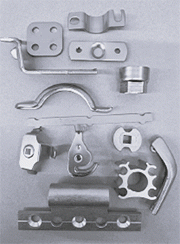
(!) R. B.: Partially! We found that straightforward deburring/surface smoothing operations of simply shaped work pieces made from zinc, aluminum, brass, steel, and wood can be run as “dry” processes. With specially developed plastic and ceramic grinding media we achieved good results on, for example, buckles for belts, bags, and shoes, door handles, fittings, cut and stamped sheet metal components as well as wooden toys. Of course, the work pieces cannot be covered with any oil.
(!) R. B.: Actually, our tests were so successful that we are now actively promoting “dry finishing” processes for certain mass finishing applications.
(?) MFN: What about new developments on your equipment side?
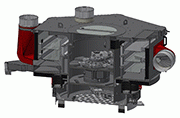
(!) R. B.: One good example is the Rösler Micro-Gap® design in centrifugal disk finishing machines. Imagine a customer needs to debur large quantities of washers with a thickness of less than 0.2 mm (!) in batches with more than 50,000 pieces. How can this be done safely without damaging the parts and making sure that batches with different part sizes do not get mixed up?
(!) R. B.: For such challenging finishing tasks we developed centrifugal disk finishing machines with a so-called Micro-Gap® between the stationary work bowl and the rotating spinner in the bottom of the bowl. Precision bearings for the spinner and special materials in the gap area, such as hard metal or polyurethane, create very tight gaps. The tightest ones are achieved with two hard metal rings – one in the bottom of the work bowl and one in the spinner. This setup ensures that the gap between work bowl and spinner never exceeds 0.05 mm and guarantees the safe processing of extremely thin work pieces: No damaged parts and no mix-up of batches with different part sizes!
(!) R. B.: Let me now give you some examples from our shot blasting division:
Recently, our French colleagues developed an innovative, extremely precise camera-based work piece recognition system. It recognizes the exact position of a work piece in a bin so that a robot can safely and reliably pick it up. It checks a work piece identifier and determines whether the machine operator has placed the correct component into the shot blast machine. Moreover, it conducts quality checks. For example, it controls if the operator has placed masking material at the right places on a work piece. This technological feature helped us secure a large equipment order from a leading French aerospace supplier.
(!) R. B.: Another example from our shot blasting division are “digital twins” of our blast turbines:
With “Multiphysics” software we created a digital model of a turbine to study the behavior of the blast media inside the turbine. We found that the model closely replicated the results of actual shot blast tests. Consequently, this “digital twin” allowed us to study the usable life of different turbine components, energy efficiency, and blast media consumption without having to conduct lengthy and costly shot blast trials. We will be using the digital model to optimize the design of a new Rösler turbine, which will be introduced in 2026.
(!) R. B.: Our shot blast engineers also developed a 2-axis manipulator for handling single work pieces with complex shapes. Such components frequently have internal surface areas that are difficult to reach during the shot blast process.
The manipulator picks up a single work piece and clamps it with a preloaded spring. Since the manipulator can rotate the work pieces around two axes, it allows perfect adaptation of the shot blast process to the work characteristics.
(!) R. B.: Let me briefly talk about preservation lines. During the past years, Rösler has become the undisputed market leader in the field of combined shot blasting and painting of large steel components such as plates, beams, and complete steel weldments. This did not happen by accident but became possible through numerous technical innovations.
For example, we are utilizing the exhaust heat from the pre-heater in the shot blast machine to guide it to the paint dryer. This significantly reduces the drying time of the applied paint on the steel components.
Or, prior to the paint process, special sensors precisely measure the work piece dimensions – down to the last mm. The gantry holding the spray guns is then programmed to these measurements. This minimizes overspray.
Rösler also uses a patented brush as a pre-separator for the paint mist in the paint booth. This increases the usable life of the paint filters by a factor of 5 to 7, representing a huge cost saving.
(!) R. B.: Another Rösler success story is additive manufacturing: We have become the leading supplier for post processing of 3D printed components. Through our brand AM Solutions we offer the latest post processing technologies ranging from de-powdering, support removal, component cleaning to surface-smoothing and high gloss polishing.
(?) MFN: Can you be a bit more specific?
(!) R. B.: Of course! For example, our innovative S1 system combines the cleaning and surface finishing function into one single step with one single processing medium. By replacing his old post processing system with three S1 machines, a customer using an SLS printing process was able to make his post processing operation a lot more cost-effective. He not only cut the processing times in half, which greatly reduced his electricity and compressed air usage, but he was also able to reduce his blast media usage by more than 60%.
(?) MFN: Rüdiger, would you like to add any additional remarks?
(!) R. B.: Our business environment is no doubt rapidly changing. To remain successful, we must adapt to these changes. In this respect, we are also looking at utilizing artificial intelligence for mass finishing and shot blasting operations.
At the moment we study whether the creation of AI-based models of typical mass finishing and shot blasting processes could help us monitor these processes and determine if the underlying process parameters are deviating from their preset range. We have been quite successful with our “Smart Solutions” software. But combining this with the huge data quantities handled by AI models could be a huge step towards digitizing mass finishing and shot blasting processes.
MFN would like to thank Rüdiger Böhm for this interview!
For Information:
Rösler Oberflächentechnik GmbH
Vorstadt 1, 96190 Untermerzbach, Germany
Tel. +49.9533.924-802
E-mail: d.hund@rosler.com
www.rosler.com




 BACK
BACK