
E-Archive
 BACK
BACK
Articles
in Vol. 27 - May Issue - Year 2026
Control the Mix, Control the Process: Why Operating Balance Defines Shot Blasting Performance
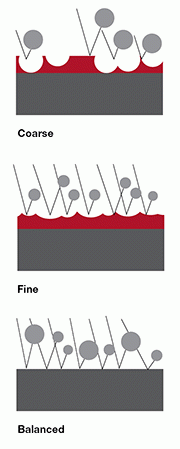
A balanced operating mix

Checking surface profile after blasting

The Ervin Spot Check Kit

Control the operating mix
In modern surface preparation, shot blasting is expected to deliver repeatable cleanliness standards, tightly controlled surface profiles, and maximum throughput efficiency. Turbine design, machine maintenance, and line speed are all closely monitored.
Yet one variable continues to cause the majority of blasting inconsistencies - the abrasive operating mix.
Across the industry, a significant proportion of blasting problems can be traced back to imbalance within the circulating abrasive. Cleaning inefficiency, rising consumption, unstable roughness values, and premature machine wear often share the same root cause: a mix that has drifted away from its optimal particle distribution.
For technically advanced operations, controlling the operating mix is not optional. It is fundamental process management.
Understanding the Dynamics of the Operating Mix
In a recirculating blast system, abrasive is not static. Every impact alters the particle. Even the highest quality steel shot gradually reduces in size through controlled wear.
Premium abrasives are engineered to wear progressively, maintaining structural integrity as they reduce in diameter. Inferior materials, by contrast, tend to fracture unpredictably, generating excessive fines and increasing dust load and consumption rates.
As particles wear, smaller fractions are removed through the air wash separator and dust collection system, while new material is added to maintain working charge. Over time, this creates a working distribution of particle sizes inside the machine - the operating mix.
A stable, optimised operating mix contains:
• Larger particles delivering high kinetic energy
• Medium particles contributing both impact and distribution
• Fine particles providing coverage density and access to complex geometries
The interaction between these fractions determines cleaning efficiency, surface uniformity, and profile control.
Impact Energy Versus Coverage Density
From a physics standpoint, larger particles carry greater mass and therefore higher kinetic energy at a given velocity. They are highly effective at removing scale and heavy contamination. However, their larger diameter limits the number of impacts per kilogram and increases spacing between impact points.
This can result in incomplete surface coverage, particularly on intricate geometries.
Smaller particles, conversely, generate far more impacts per kilogram. While individual impact energy is lower, coverage density increases significantly. They penetrate corners and complex profiles more effectively.
If the operating mix becomes too coarse:
• Surface coverage decreases
• Cleaning may appear aggressive but inconsistent
• Surface profile may exceed specification
• Abrasive consumption can rise due to inefficient removal patterns
If the mix becomes too fine:
• Impact energy drops
• Heavy scale removal becomes slower
• Blast times increase
• Energy costs rise
• Required roughness values may not be achieved
Optimal performance depends on balance; sufficient mass for effective cleaning combined with enough particle count for uniform coverage.
Particle Count: The Hidden Multiplier
Particle count per kilogram is rarely discussed, yet it plays a critical role.
A nominal 1 mm cast steel shot (for example, S390) contains roughly 200,000 particles per kilogram. A stable operating mix within a well-controlled blast system may contain several times that number due to the presence of smaller worn fractions.
This dramatically increases the number of impacts delivered to the workpiece per unit time.
More impacts (provided adequate energy is maintained) translate into:
• Improved surface uniformity
• Reduced shadowing
• Greater repeatability
• Shorter effective blast cycles
Ironically, operators sometimes discard this optimised working mix unintentionally through incorrect separator settings or uncontrolled losses, replacing it with fresh abrasive that lacks the established distribution required for peak performance.
The Metallurgical Contribution of Quality Abrasive
Material quality directly influences operating mix stability.
High-grade cast steel abrasive does not simply reduce in size; it work-hardens during use. Repeated impacts induce a measurable increase in surface hardness, enhancing wear resistance and maintaining cleaning efficiency over time.
Lower quality materials tend to fracture before this beneficial hardening can occur. The result is unstable size distribution, excessive fine generation, and increased dust load - all of which disturb separator balance and accelerate consumption.
The abrasive inside a well-managed machine is often performing better than newly delivered material, precisely because it has stabilised through controlled wear and work hardening.
For this reason, abrasive selection and process control must be considered together.
Secondary Effects: Consumption, Wear and Coating Performance
Operating mix imbalance does not only affect cleaning performance. Its impact extends to overall plant efficiency and downstream quality.
Abrasive Consumption
A coarse-dominated mix reduces particle count and coverage efficiency, leading to longer blast cycles and higher throughput of material through the system. A fine-dominated mix may increase dust removal rates. Both scenarios increase consumption unnecessarily.
Machine Wear
An incorrect mix can accelerate wear on critical components, particularly wheel blades and control cages. Excessively coarse fractions may increase localised impact stress, shortening component life.
Surface Roughness and Coating Integrity
For operations applying protective coatings after blasting, operating mix control becomes even more critical.
Small deviations in Rz, Ra, or peak count values may appear insignificant in isolation, but they directly influence coating adhesion and long-term corrosion resistance. An unstable profile can compromise protective performance against aggressive environmental exposure - moisture, salts, chemicals, and atmospheric pollutants.
In high-specification sectors, profile control is not aesthetic; it is functional.
A balanced operating mix supports predictable roughness development and consistent anchor patterns, safeguarding downstream coating performance.
Monitoring and Maintaining Control
Maintaining a stable operating mix begins with disciplined abrasive addition practices. Frequent, small additions of the correct specification material are preferable to large, irregular top-ups.
However, addition control alone is insufficient.
Operators must also monitor material losses:
• Separator rejects
• Dust collector discharge
• Leakage from the blast cabinet
• Carry-out on processed components
Uncontrolled losses distort size distribution and gradually destabilise the mix.
Specification accuracy is equally important. Receiving abrasive outside the ordered size range - particularly oversized material - can immediately shift the operating balance, reducing cleaning efficiency and altering surface profile characteristics.
For detailed evaluation, full sieve analysis using multiple calibrated screens provides comprehensive data. This approach, routinely supported by the technical teams at Ervin, delivers precise measurement of size distribution and separator efficiency.
However, daily production environments require something faster and simpler.
Practical Process Control: Rapid Operating Mix Assessment
To support consistent monitoring, Ervin has developed the Ervin Spot Check Kit - a portable diagnostic system enabling operators to assess operating mix condition in approximately five minutes.
The kit provides a clear visual indication of whether the abrasive is:
• Coarse biased
• Fine biased
• Within optimal range
No complex laboratory procedure is required, and production can continue during assessment.
When integrated into routine quality checks, rapid monitoring allows facilities to:
• Detect drift before performance declines
•• Adjust separator settings accurately
Optimise abrasive addition rates
• Maintain consistent surface profiles
• Reduce avoidable consumption
The objective is not merely troubleshooting; it is proactive control.
From Abrasive Supply to Process Partnership
As performance expectations in surface preparation continue to rise, abrasive manufacturers must contribute more than material supply.
Technical collaboration - including process analysis, separator optimisation, consumption tracking and profile measurement - enables blasting operations to transition from reactive problem-solving to structured optimisation.
By combining premium steel and stainless steel abrasives with hands-on technical expertise and practical monitoring tools, Ervin works alongside customers to improve measurable outcomes:
• Reduced cost per tonne processed
• Lower abrasive consumption
• Extended component life
• Stable surface roughness compliance
• Increased throughput efficiency
In competitive industrial environments, marginal gains compound rapidly into significant operational advantage.
A Process Under Control
Shot blasting is often viewed as a consumable-driven process. In reality, it is a highly controllable mechanical system - provided the operating mix is properly managed.
When particle distribution is balanced, separator performance optimised, and material quality assured, blasting becomes predictable, efficient and repeatable.
The principle is straightforward: control the operating mix, and you control the process.
For surface preparation professionals seeking greater productivity, improved coating reliability and reduced total cost, operating mix management represents one of the most powerful and underutilised tools available.
For Information:
Ervin Germany GmbH
Rudower Chaussee 48
12489 Berlin, Germany
Tel. +49.30.400 37846
E-mail: info@ervin.eu
www.ervin.eu