
E-Archive
 BACK
BACK
Science Update
in Vol. 27 - May Issue - Year 2026
Shot Peening Coverage Classification Using Convolutional Neural Networks

Figure 1: Representative images for each of the eight categories of coverage. The numbers are percentages.
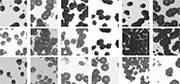
Figure 2: Images showing the increasing strategy applied during training

Table 1: Hyperparameters of the CNN

Figure 3: Training validation plots

Figure 4: Correct image predictions
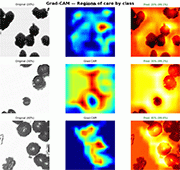
Figure 5: The resulting heatmaps, reveal a consistent and physically coherent pattern of attention
Introduction
As machines, vehicles, and structures are not immune to dynamic or alternating stress, material failure due to fracture, and particularly due to fatigue, is considered the primary cause of failure in mechanical components within two economically significant sectors: the automotive and aeronautical industries [1].
In general terms, it is possible to provide surface protection for a wide variety of engineering components against mechanical damage and corrosion through processes such as thermal spraying, infiltration, physical vapour deposition, chemical vapour deposition, powder metallurgy/synthesis, heat treatment, laser heat treatment, shot peening (SP), or laser peening. All these methods involve altering the surface, either by depositing a homogeneous layer of a different material onto the substrate/base material or by altering the residual stresses in the region near the material’s surface.
Thus, the fatigue resistance of a metallic material is governed by its resistance to crack propagation, which may well be due to grain or phase boundaries and, in general, all types of barriers to plastic slip that occur within the material. To condition the surface so that it resists crack propagation, the SP process is used, which is defined as bombarding the surface with hard pellets (shots) onto the surface to be treated, introducing many and varied forms of barriers due to the distortion of the surface and subsurface [2]. The shots plastically deform and indent the surface.
In this sense, SP requires the measurement and control of several variables, such as the size of the shot and the material to be impacted; the nozzle movement, that includes massic flow of the shot, angle and speed of the balls; and lastly, the indents and exposure time. Indents, or dimples, are usually considered as coverage. Coverage is defined as a measure of the fraction of a surface area that has been impacted, i.e., a percentage of obliteration of the original surface. Coverage also represents a measure of the uniformity of the residual stresses in the subsurface layer.
Thus, coverage is very important, given that less than complete coverage would contribute to an uneven distribution of the residual stresses and, consequently, the possibility of having crack nucleation and eventually crack propagation. In order to determine coverage more efficiently and reliably, machine learning techniques are being developed. Some research works on coverage through image analysis were reported [3–6].
In the present study, a convolutional neural network model is proposed for discriminating peened from unpeened areas of a 2024-T351 aluminium alloy.
Methodology
SP was conducted on 2024-T351 aluminium alloy (AA) specimens (a widely used material in aerospace applications) with dimensions 25 by 19 by (5–7) mm. The width of 19 mm was similar to the width of the Almen strips in order to facilitate the clamping on the holding fixture. A thickness greater than 5 mm was utilised to minimise the typical double deformation after peening, as well as to avoid the end effects.
To develop a supervised classification model, a dataset is required such that it constitutes the physical phenomena, and it should also be sufficiently large to achieve generalization. However, the acquisition of large volumes of original microscopic images is ordinarily limited by the availability of samples at each specific coverage level. To address this restriction, a structured image augmentation strategy was implemented to build up the training dataset.
Original images were captured (optical microscopy) for each of eight coverage categories: 20%, 30%, 40%, 50%, 60%, 70%, 80%, and 90%. For each category, 20 base images were acquired under consistent conditions. Subsequently, each base image underwent data augmentation using systematic rotational sampling in 10-degree increments across the full 360° range. This process generated 720 images per category, resulting in a balanced dataset of 5760 images in total.
All images were stored in greyscale with a resolution of 128×128 pixels. This format preserves the textural information that is relevant for the assessment of coverage, i.e., the density, distribution, and degree of overlap of the hammer marks, whilst minimising the computational load during model training.
Representative examples of each coverage category are shown in Fig. 1. The gradual visual transition from isolated, well-defined gaps with 20% coverage to a saturated, fully overlapping texture with 90% coverage confirms that the categories are physically distinguishable and suitable for image-based classification.
A classification model based on a convolutional neural network (CNN), specifically designed for the analysis of SP images, is used. The architecture is organised into two functional stages: a convolutional (CFE) feature extractor and a fully connected neural network (NN). The CFE comprises four progressive convolutional blocks.
Each of the first three blocks contains two consecutive Conv2d layers followed by batch normalisation and ReLU activation, a max-pooling layer that halves the spatial dimensions, and a dropout layer for regularisation. The filter depth doubles with each block (32, 64, and 128 filters, respectively), allowing the model to progressively capture low-level textures in the early layers and more complex structural patterns in the deeper ones.
The fourth block maintains a depth of 256 filters without spatial pooling, preserving the representational capacity prior to aggregation. A Global Pooling Average Operation (GPAO) layer condenses each feature map into a single scalar, generating a compact 256-dimensional descriptor and significantly reducing the number of parameters compared to a flattening operation.
The core operation of each convolutional block is the discrete 2D convolution, which extracts local features by sliding a learnable kernel K across the input image I according to the following mathematical expression:
(I*K)(i,j) = ∑∑I(i-m,j-n)K(m,n)
where, (I*K)(i,j) is the value of the resultant pixel at position f in the new image. I(i-m,j-n) is the value of the pixel in the original image, which is moving. K(m,n) is the filter value at the position.
∑∑ represents the sum of the products obtained by sliding the kernel across the entire neighbourhood of the pixel.
The classification layer consists of two fully connected layers with 512 and 256 units, respectively, each followed by batch normalisation, a ReLU activation function, and dropout regularisation with rates of 0.50 and 0.40, respectively. The final layer maps the 256-dimensional representation to the 8 output classes using a Softmax activation function, yielding a probability distribution over the coverage percentages.
The model was trained using the Adam optimiser with a learning rate of 1×10⁻³ and L2 regularisation of 1×10⁻⁴. The full hyperparameter configuration is summarised in Table 1. The data increasing strategy applied during training—horizontal and vertical flipping, random translation, and brightness fluctuation—reflects the isotropy of the images, which do not exhibit a preferred spatial orientation, as shown in Fig. 2. This augmentation effectively increased the variability of the training distribution without introducing unrealistic image artifacts.
Results and discussion
The initial learning rate of 1×10⁻³ proved sufficient for full convergence. The training and validation curves are shown in Fig. 3. Finally, a visualisation of correct and incorrect predictions made during model training is provided. The correct predictions can be seen in Fig. 4.
To assess whether the classification decisions have physical meaning, gradient-weighted class activation mapping (Grad-CAM) was applied to representative images from each of the eight land cover categories. Grad-CAM calculates the gradient of the predicted class score with respect to the feature maps of the final convolutional layer, generating a spatial heatmap that highlights the regions of the image most influential on the output (Fig. 5). This technique provides a direct and interpretable link between the internal representations of the NN and the visual characteristics of the SP.
Conclusions
Determination of the coverage of SP areas was carried out using a convolutional neural network and the Adam optimiser, as well as gradient-weighted class activation mapping (Grad-CAM). The network learnt to extract textural descriptors relevant to coverage rather than overfitting to the specific noise of the dataset. The interpretability offered by Grad-CAM is particularly relevant for industrial applications because it provides a visual verification tool that bridges the gap between the model’s numerical output and the physical appearance of the inspected surface.
References
[1] Y.-S. Nam, U. Jeon, H.-K. Yoon, B.-C. Shin, and J.-H. Byun, "Use of response surface methodology for shot peening process optimization of an aircraft structural part," The International Journal of Advanced Manufacturing Technology, vol. 87, no. 9, pp. 2967–2981, 2016/12/01 2016, doi: 10.1007/s00170-016-8690-5.
[2] J. González, L.-B. Peral, C. Colombo, and I. Fernández Pariente, "A Study on the Microstructural Evolution of a Low Alloy Steel by Different Shot Peening Treatments," Metals, vol. 8, no. 3, p. 187, 2018. [Online]. Available: https://www.mdpi.com/2075-4701/8/3/187
[3] L. Shahid, F. Janabi-Sharifi, and P. Keenan, "Image segmentation techniques for real-time coverage measurement in shot peening processes," The International Journal of Advanced Manufacturing Technology, vol. 91, no. 1, pp. 859–867, 2017/07/01 2017, doi: 10.1007/s00170-016-9756-0.
[4] M. Handa, Y. Watanabe, and K. Hattori, "Suggestion of Image Processing System for Measurement of Coverage," The Shot Peener, pp. 30–34, 2005.
[5] T. Wang, J. Zhang, S. Zhang, X. Zhang, and J. Wang, "A combined computer vision and image processing method for surface coverage measurement of shot peen forming," Journal of Manufacturing Processes, vol. 91, pp. 137–148, 2023/04/07/2023, doi: https://doi.org/10.1016/j.jmapro.2023.02.035
[6] J. S. Romero, "Coverage Determinations Through Fuzzy C-Means Clustering," MFN International (Metal Finishing News), pp. 50–52, 2024.
Affiliation:
Public Education Secretary of Mexico
Tecnológico Nacional de México/IT de
Tlalnepantla centro, Postgraduate Office
E-mail: jose.sr1@tlalnepantla.tecnm.mx