
E-Archive
 BACK
BACK
Articles
in Vol. 26 - March Issue - Year 2025
To The Finish – Choosing Tumbling Techniques

Steve Alviti,The President and Owner of Bel Air Finishing Supply
Mass finishing may be one of the least understood processes in the jewelry industry. Many manufacturers believe that achieving the best finish is a simple process involving media, solvent, and some type of tumbler—vibratory, disc centrifugal, magnetic, etc. What they don’t realize is that many factors determine the best way to finish a piece; there is no “one size fits all” approach.
To illustrate this, I’d like to draw on my 25 years of experience as a mass finisher and offer three examples, each involving the same type of jewelry—but with subtle differences.
A manufacturer came to me with the problem of how to best finish 14k hoop earrings made from thin-walled gold tubing. The tubing had been fabricated from wrought strip stock of only fair quality, so the earrings had a poor surface appearance. Also, the hoop’s radial geometry made hand polishing very difficult. Since these pieces were going to high-end jewelry stores and needed a high-quality finish, I suggested a two-step process: a wet pre-polish to smooth the surface, followed by a dry polish in vibratory bowls. This eliminated hand finishing and achieved the desired look.
At the same time, I had another customer who made almost the exact same piece of jewelry, which he sold to the same stores; the only difference was that this company made its own strip stock, which was of better quality than the wrought material. In that situation, we set up a one-step dry vibratory process with a longer time cycle. This resulted in an excellent surface finish and a drastic reduction in scrap loss compared to hand polishing.
Another customer was manufacturing the same type of earring, but he used base metal that he then electroplated. Since he sold to outlet stores, packaging three pairs of earrings on a card and filling orders for thousands at a time, he did not need as high a polish. What he did need was fast, high-volume output. We decided on a one-step burnishing operation using porcelain media. While it did not provide as fine a finish as dry polishing, it sped up the process and ultimately saved him time and money.
As these examples show, there are many different roads to take when it comes to deciding on a mass finishing method. The design, the metal, and the way the piece is marketed must all be considered when deciding on a process. Most importantly, the manufacturer must consider the intended buyer. If beauty is in the eye of the beholder, then it’s the ultimate consumer who will dictate the surface finish needed to sell a product. To be successful, manufacturers must seek the best method to achieve that finish while still containing costs and increasing productivity.
Whether you do in-house finishing or contract it out, the approach to finding that method remains the same: Understand the fundamentals of mass finishing and zero in on what you want to achieve. In this article, I’ll sketch a road map that will show you how to set specific goals, avoid traveling down dead-end avenues, and take the right forks on the path toward saving time and money.
To Mass Or Not To Mass
Before even setting out on the road, you should first ask yourself one question: Should you be doing mass finishing? For many manufacturers, the process offers several advantages: It significantly reduces labor costs inherent in grinding and/or hand polishing, increases consistency of quality, and improves productivity by as much as 90 percent. It will also minimize precious metal loss in fine cast goods. A ring processed through mass finishing typically loses only 1 to 2 percent of the total alloy, compared to an average of 5 to 10 percent with hand polishing.
However, mass finishing is not for everyone. If you have products made from sheet stock or stampings, and you’re planning to sell them to a high-end retailer such as Tiffany’s, you will ultimately need hand buffing to achieve the necessary luster. In such a case, any preliminary mass finishing will have a negligible effect and will simply be a waste of time and money. (If you plan to sell a cast item to Tiffany’s, however, then you’d want a dual operation: mass finishing to remove the casting skin, followed by hand polishing.)
To determine whether mass finishing truly is for you, first take a look at your current costs for hand polishing. Often, you’ll find that mass finishing can significantly reduce those costs. For example, a bench worker spends an average of three hours each day on finishing operations such as rubber wheeling, filing, sanding, cutting, and glossing. His wage is $10 an hour, and he performs those functions three hours every day, five days each week, fifty weeks per year. That equals $7,500 in labor costs—not including files, emery, wheels, and polishing compound.
On the other hand, the most basic finishing systems can be installed for about $2,500, which includes a year’s worth of supplies. As long as you have other tasks for workers to accomplish, the equipment will pay for itself in less than one year. Even if you are a one-man operation and do very low-quantity production, there are small laboratory-type equipment and systems available for under $500. In my experience, there are very few manufacturers who wouldn’t benefit from some type of mass finishing system.
If the savings add up and you decide to take the path toward mass finishing, you must be very definite about what you want to achieve. And to make that decision, you must know what your customers want and what they are willing to pay. You must also be wary of manufacturing costs that can price you out of what has become an increasingly competitive market.
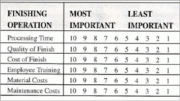
The next time you sit down to analyze how you will get a product out the door, from raw materials to finished goods, it will make a world of difference if you decide upfront what your priorities should be in the finishing area. A simple table (below) ranking several key areas in importance—processing time, quality of finish, employee training, material costs, and maintenance costs—can assist you in focusing on your most important areas.
Once you’ve established which areas are most important, you must next pair this information with the finishing options available. And for that, you need to understand the roles of the three components of mass finishing: compounds, media type, and equipment. Like the tumblers on a safe, the combination of these three components will make all the difference between success and failure.
Finishing Compounds
These compounds, available in both liquid and powder forms, are used as water additives during wet finishing operations. They serve three purposes: to suspend the solids being removed from the surface of the product (much like dishwashing soap), to prevent oxidation or discoloration of the metals being processed, and to add lubricity.
Compounds are used in both types of mass processing: batch operations (where a prescribed amount of media, water, and compound is placed in a sealed process chamber) and flow-through operations (where water and compound continuously flow in and out of an open processing chamber). Theoretically, compounds are most likely to be changed based on the particular metal being processed, as well as the specific step (i.e., rough cut, pre-finish). However, most manufacturers settle on one “all-purpose” compound best suited for their needs. Your supplier should be able to help you match the compound with the media and equipment you’re using.
Media Shapes And Sizes
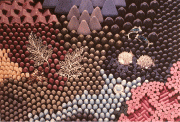
When it’s time to choose the correct media, you’ve reached the first fork in the road. There are several different types, each with its specific function:
Cutting Media
Used for the initial rough cut of a product, cutting media removes all possible surface imperfections. This step is almost always done as a wet operation with media, water, and compound. Depending on the manufacturing process—casting, rolling, forming, etc.—some preliminary handwork may be necessary (e.g., a raw gold casting would need to have the sprue cut off and ground down to the surface).
Normally, cutting media has two components: abrasive grains and a carrier (or bonding agent). Abrasive grains for cutting media can be silicon carbide (most aggressive), aluminum oxide (moderately aggressive), and silica (least aggressive). Bonding materials can be ceramic (hard), plastic (softer), and natural (e.g., wood, nutshell, or corn cob, which range from soft to hard). Bonded plastic is viewed as the best choice for multiple cutting options.
Pre-Polishing Media
Pre-polishing media is much the same as cutting media, except the size of the abrasive grains is smaller. This stage also employs a greater flow of water and a compound that lubricates more effectively; the combination creates a gentle honing action that reduces the surface to a finer, smoother finish.
Burnishing Media
This media contains no abrasive grains and rolls over a piece of jewelry, hammering away at the metal surface for the sole purpose of making it bright and hard. When the overall brightness of a jewelry item ranks highest in importance, rather than the surface finish itself, a burnishing method becomes the logical choice. Porcelain, carbon steel, and stainless steel provide the best results.
Polishing Media
This type of media usually has a natural base, such as wood, nutshell, or corn cob; its purpose is to replicate the action of a polishing wheel. Polishing compounds similar to those used in hand polishing bars are bound to the natural polishing media by means of a wax or oil-based agent.
Polishing operations are usually done by a dry process (without water flow) and typically take longer than either the rough cut or the pre-polish stage. Assuming a metal surface has been rendered smooth and flat, the polishing media will produce a high luster—though it will never equal that achieved through hand polishing.
The media for all of these stages come in many shapes—pyramids, cones, tri-stars, wedges, among others—as well as various sizes. When deciding which to use, you must consider the geometry of the part being processed and choose the largest media possible that will fulfill the following criteria:
- The shape can touch every part of a workpiece’s surface.
- The size of the media facilitates easy separation (i.e., either the media or the piece can be sifted through a separating screen).
Once you’ve selected the media, you’re ready to examine your next set of choices: the type of tumbling equipment you’ll use.
Finishing Equipment
Although the media performs the cutting action and creates the ultimate surface finish, the mass finishing equipment supplies the energy to do the work.
One important point to remember when deciding on equipment: You must focus not only on the quality of the finish but also on the cost involved. Imagine driving a Lamborghini to the grocery store while your friend drives a Chevrolet. You may get there faster and in better style, but your friend will get to the same grocery store for less money per mile. So it goes for mass finishing equipment: The higher the upfront and maintenance costs, the higher the finishing cost per piece. That said, here are your options:
Rotary Tumbling
This is the oldest type of mass finishing in use. The mass of jewelry pieces and media rotates within an octagonal chamber, rising to the top of an incline before tumbling down and starting over again.
Rotary tumbling has severe limitations since, during half of the cycle, the media does not move against the pieces; consequently, you’ll have a longer time cycle that yields a low-quality finish. This type of system also does not offer flow-through capabilities, so wet compounds aren’t an option—a definite drawback. Still, this is a good machine for finishing flat pieces that tend to “nest” together in other types of equipment, as well as for small lots that need a quick burnishing operation without high quality.
Vibratory Bowl Machines
Introduced two decades ago, these vibratory bowls remain the most popular, effective, and cost-saving of all tumbling units. (Bowl machines hold more load, take less labor to unload, and have a relatively low initial cost compared to other systems.) Features include low maintenance costs, a flow-through system for liquid compounds, and a high concentration of jewelry pieces relative to the total mass in the bowl. With the exception of light, flat pieces, any product can achieve a high polish in a vibratory bowl. It even works with chains.
High-Energy Barrel Machines
These units operate much the same as rotary tumblers, except they feature centrifugal energy to reduce processing time. Several barrels are mounted Ferris-wheel fashion, and the complete apparatus spins as the barrels rotate. This system does minimize process time, but it also has several drawbacks: It’s not adaptable to a flow-through system, it can’t finish pieces with deep recesses, and it has a high initial cost. Generally, this is not a well-rounded choice for finishing.
High-Energy Disc Machines
These systems combine the three-dimensional action of the vibratory bowl machine with the reduced processing time of centrifugal force units. They greatly reduce process time—a major benefit—and permit flow-through action. However, their design presents certain maintenance problems (e.g., there is a gap between the two rotating components of the finishing chamber through which abrasive residue can flow, jamming the gap and damaging the disc; caution must be exercised). That, coupled with the high initial cost, results in a higher cost per finished piece.
Roll Burnishing Machines
These machines are relatively new to mass finishing. They offer a much faster process time and are adaptable to flow-through operation. In addition, the unloading system, in which an easily removed sieve separates media from the workpieces, enables operators to remove the pieces in less than one minute without handling the media. On the other hand, they cannot process very fine, thin workpieces, and they’re not good for chains.
Magnetic Pin Machines
In these systems, very fine pins or needles combine with a compound mix to burnish the nooks, crannies, and hard-to-reach areas of jewelry pieces. They provide an excellent burnished look, but to achieve a high-quality finish, the pieces must usually be subjected to additional operations in other equipment. That, along with poor-quality finishes on smooth surface areas and no flow-through capability, are the system’s drawbacks.
Additional Considerations
When considering any of these machines, you should also remember a few additional points:
- Many manufacturers, when they consider process times, don’t realize that wet processing is accomplished during the normal eight-hour workday, but dry polishing can be done overnight; by the next morning, the process is complete.
- Mass finishing machines also save on costs and time by freeing workers to set stones or perform other tasks instead of sanding and polishing.
- One consideration that continues to grow for manufacturers is the handling of wastewater generated from a wet finishing process. Initially, such waste posed a major problem for costume jewelry makers whose alloys contained lead, cadmium, or copper. Now, compact systems can easily collect these metals and render them either harmless or easily recoverable; the rigors of handling hazardous materials are eliminated.
Putting IT All Together
To see how this entire decision-making process can work, let’s backtrack to the table listing the least and most important areas of finishing. Let’s say you’re a manufacturer of cast gold rings. You’ve determined that processing time was of minimal importance (it rated a three), while the cost of finishing ranked highest (10). The quality of finish scored a five, and training employees, maintenance costs, and material costs all received eights.
Since you’re working on slim margins, without a maintenance staff or a ready pool of trained polishers, you’ll want to keep costs low and capture as much gold scrap as possible. The best process would be two-step: a wet cut with plastic media and a wet burnish with porcelain media. This would completely eliminate the hand-polishing operations.
Now you can decide on the equipment. Immediately, you can rule out high-energy machines because of their need for maintenance and the high cost per finished piece. You can also rule out rotary tumbling systems, which usually yield only a mediocre finish, and magnetic tumblers, which handle only small volumes. Two options remain: vibratory bowl or vibratory tub finishing. For the same cost of equipment, we chose the three-dimensional action of a bowl versus the two-dimensional work of a tub.
Mass finishing procedures will always be governed by the estimated cost of the final product and what value the customer expects for money spent. A pair of diamond-set cast gold earrings for an upscale retailer would probably be rough cut in a vibratory bowl and then hand-polished. The same style earrings, cast in gold with imitation stones and sold at a dramatically lower price throughout a large retail chain, would lend itself to a three-step mass finishing process—rough cut, pre-polish, and final vibratory polish. And, for that same earring cast in low-karat gold, without a stone and aimed at consumers who are not interested in high fashion, a simple burnishing operation may be sufficient to bring the brightness up to salable quality.
The choice is yours.
For Information:
Bel Air Finishing Quonset Industrial Park, 101 Circuit Drive, North Kingstown, RI 02852, USA
Tel. +1.401.667-7902
E-mail: info@belairfinishing.com