MFN was able to get an interview with Ryan Ashworth, Head of Sales and Marketing, Vapormatt Ltd.
(?) MFN: Vapormatt has deep roots in aerospace. How did that relationship begin?
(!) R. A.: Our connection with aerospace goes right back to the origins of wet blasting. In the late 1940s, Norman Ashworth developed the first wet blasting machine while working alongside Sir Frank Whittle on the development of the jet engine, so the technology and the industry really did grow up together. The Ashworth family owns and runs Vapormatt to this day. World-leading aerospace engine manufacturers have trusted Vapormatt ever since, and that heritage shapes how we approach every project today.
(?) MFN: How does wet blasting differ from conventional dry blasting, and why does that distinction matter in aerospace?
(!) R. A.: The core difference is that, in wet blasting, the abrasive media is suspended in water to form a slurry before being accelerated onto the component surface. The water cushions and lubricates the media, which moderates the impact and produces a more controlled, uniform finishing action.
For aerospace, that matters considerably. Dry blasting can be aggressive; it generates substantial dust, the media breaks down faster, and the resulting surface tends to be less refined. Wet blasting removes oxides, carbon deposits, machining residue, and old coatings while keeping the risk of surface damage very low, which makes it well suited to parts with tight tolerances, complex geometries, and demanding surface specifications.
(?) MFN: What are the main manufacturing applications where you see wet blasting used?
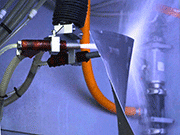
(!) R. A.: There is quite a range. Wet shot peening is one of the most significant. The process projects a mixture of water and small, hard spherical media particles at turbine blades, fan blades, blisks, discs, driveshafts, and engine casings to introduce compressive stresses that dramatically improve fatigue strength. Turbine blade service life can be extended by over 1,000% through peening, and the wet process achieves deflections of up to 0.39N and 0.38A, respectively, while producing a superior surface finish and eliminating any risk of non-ferrous contamination.
Beyond peening, we support a wide range of other OEM applications: preparing composite fan blades, propeller blades, and helicopter blades for bonding and coating; cleaning components before NDT crack detection; preparing surfaces for PVD and CVD coatings; finishing cast components by removing casting resist, burrs, and heat scale; cleaning forged parts such as landing gear struts, compressor discs, and engine shafts after thermal processing; and post-process finishing of additively manufactured components.
We have also supplied systems that finished components destined for space. The cutting inserts on the Mars Rover’s drill were finished in a Vapormatt Tiger machine, which gives you a sense of the precision involved—in this instance, a tolerance of ±2 µm.
(?) MFN: You mentioned composites and additive manufactured components. Can you say more about those?
(!) R. A.: Both are growing areas for us. With composites—whether fan blades, propeller blades, helicopter rotor blades, or structural panels—wet blasting cleans the surface thoroughly, removing waxy residues and other contaminants while simultaneously creating a consistent "wet-out" surface that ensures even, complete coverage. The cushioning effect of the water means composite fibres are not damaged during processing, so the integrity of the component is preserved throughout. When you are bonding titanium leading edges to fan blades or attaching heater mats to propeller blades, that bond strength is critical.
Additively manufactured components present a different challenge. They often feature complex internal channels that need to be cleared of powder and partially sintered material. Wet blasting works particularly well here because the slurry flows through those channels and provides a clear visual indication that they are open. Dry blasting cannot offer that confirmation and can actually compound the problem by packing more media into a blockage.
We support metal, composite, and polymer AM components across both OEM and MRO operations.
(?) MFN: What about the MRO side? Where does wet blasting add the most value there?
(!) R. A.: MRO covers a wide spectrum, and wet blasting is relevant across most of it. For jet engines, we support the thorough cleaning of fan blades, turbine blades, nozzle guide vanes, discs, blisks, engine seals, compressor vanes, and casings, removing oils, grease, heat scale, combustion deposits, and other service contamination before NDT, repair, or recoating.
One important advantage over dry blasting is that wet blasting does not peen over cracks. The flowing slurry cleans cracks out rather than closing them, which makes defects more visible during inspection and directly improves safety.
Aircraft wheels and brakes are another major area. They experience enormous stress during landing and require regular NDT. Our specially developed plastic-media-based wet blast formula rapidly cleans wheels and brakes, removing oils, grease, brake dust, corrosion, and heat scale from even the most intricate wheel geometries without affecting the painted layers or the Alodine or anodized layer underneath.
When a more thorough strip is needed, higher air pressure removes multiple coating layers in a single operation. It represents a significant time saving over manual or chemical stripping methods.
(?) MFN: Wet shot peening appears in both OEM and MRO work. What makes the wet process preferable to the dry alternative?
(!) R. A.: There are several practical advantages. Parts do not need to be cleaned and dried before processing because the wet blast process removes oils, grease, and other surface contamination during the peening cycle itself, eliminating a significant processing step.
Afterwards, there is no residual dust or media to clean from the component, which is another time-saving benefit. The finish quality is also better: the flow of media over the surface produces a smoother, more consistent result than dry peening. From a contamination standpoint, wet peening works best with ceramic or stainless-steel shot, which removes any risk of non-ferrous contamination. For materials such as titanium and certain alloys that present an explosion risk when dry blasted, the wet process eliminates the need for expensive ATEX filtration systems entirely. In addition, our patented filtration systems recycle usable media within the slurry, substantially reducing overall blast media consumption over time. It is also worth noting that wet shot peening is AMS2432 compliant.
(?) MFN: How does wet blasting support pre-inspection cleaning and NDT preparation specifically?
(!) R. A.: Inspection reliability depends on surface cleanliness. If a component carries oils, oxides, carbon residues, or remnants of old coatings, these can mask defects or produce unreliable results. For fluorescent penetrant inspection, eddy current testing, and other NDT methods, the surface must be clean and consistent before inspection begins.
Wet blasting removes adhered contamination very effectively, and because it does not peen over cracks, it actively improves defect visibility rather than concealing it. The slurry cleans into cracks rather than sealing them, which is the opposite behaviour to dry blasting. We have published case studies with the Royal Air Force and the Royal Navy that demonstrate this in operational wheel and brake shop environments, where the improvement in inspection throughput and accuracy was significant.
(?) MFN: How does the process prepare components for advanced coatings such as PVD and CVD?
(!) R. A.: Coating performance depends on what is happening at the substrate level. Whether the application involves paint, PVD, CVD, or adhesive bonding, the surface needs to be clean and have the correct roughness profile for adhesion.
In manufacturing, wet blasting creates the specific Ra surface roughness required for optimum coverage and bond strength. For PVD and CVD coatings on fan and turbine blades—which both protect the surface and improve fuel efficiency by making the blades smoother—the bond must be as strong as possible because these components operate under extreme conditions.
In MRO, the same process removes old coatings and prepares the surface for repair or recoating. Because the process is adjustable across multiple variables, the balance between cleanliness and surface profile can be precisely controlled without over-processing the part, which is critical when working with components that have tight repair limits.
(?) MFN: How important is repeatability to aerospace customers, and how does Vapormatt deliver that?
(!) R. A.: It is fundamental. Aerospace is a highly regulated environment, and customers need a process they can validate, document, and reproduce consistently, whether across production batches in manufacturing or repair routes in MRO. A surface condition achieved today must match the one achieved six months from now.
Controlling what comes out of the blast guns is central to that, and it is an area where Vapormatt’s patented technology is genuinely second to none. We maintain a consistent AMS2432-compliant blast, even as machine components wear through normal operation.
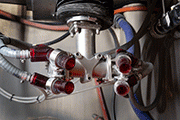
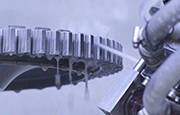
Our robotic automation can position blast guns within 0.5 mm, which is essential for intricate geometries such as the "fir tree" slots of turbine discs. Operators can control and monitor all relevant parameters through the integrated HMI, with live reporting and automatic adjustment available.
That combination of consistency and precision is what turns wet blasting from a cleaning step into a qualified engineering process.
(?) MFN: Are there any less obvious aerospace applications that are worth highlighting?
(!) R. A.: A few. Aircraft toilet cleaning tends to raise eyebrows, but it is a legitimate and practical application. In a single operation, wet blasting removes fixed and smeared contamination while creating surfaces that are much less prone to future deposit build-up. Because the process takes place inside a closed cabinet, the operator is fully shielded, which customers working under heightened hygiene protocols have found particularly reassuring.
Space components are another area. The level of process control, finishing consistency, and repeatability that wet blasting offers makes it very well suited to components where reliability is absolutely paramount. The ability to achieve a precise Ra surface roughness—typically between 0.25 and 0.6 micrometres, which is considered the optimal range for sterilisation—and then reproduce it consistently is exactly what these applications require.
Small components and fixings are perhaps underappreciated. Bolts, screws, and smaller gear parts can be loaded into a barrel system, run through a set programme, rinsed, dried, and returned ready for inspection and reuse, without the cost and time associated with cleaning individual items by hand.
Wet blasting also preserves cadmium plating and fine threads that dry blasting would otherwise damage, which is an important consideration for life-limited fasteners.
(?) MFN: What is your main message to aerospace manufacturers and MRO providers who are considering wet blasting?
(!) R. A.: Wet blasting is a surface engineering process, not just a cleaning step. In manufacturing, it supports wet shot peening, composite bonding preparation, NDT readiness, coating preparation for PVD and CVD, cast and forged component finishing, and additive manufacturing post-processing. In MRO, it supports engine component cleaning, wheel and brake preparation, undercarriage refurbishment, propeller and helicopter blade processing, coating removal, peening, and more.
In both environments, the value comes from control: the ability to remove contamination and prepare the surface without compromising component integrity or introducing variability into the process. Aerospace organisations need a method they can validate, qualify, and reproduce consistently. Wet blasting offers that combination of effectiveness, precision, and care for the component.
At Vapormatt, we always start from the engineering requirement: What is the component? What is the substrate? What needs to be removed? And what does the surface need to look like for the next stage?
That is the right way to apply this technology in aerospace, and it is the approach that has kept the world’s leading engine manufacturers working with us for decades.
MFN would like to thank Ryan Ashworth for this interview!
For Information:
Vapormatt
Ryan Ashworth, Head of Sales and Marketing of Vapormatt
Robins Drive, Bridgwater, TA6 4DL, England
Tel. +44.1823.257976
E-mail: sales@vapormatt.com
www.vapormatt.com




 BACK
BACK