A look at how integrated controls, smarter systems, and connected workflows are shaping the next generation of shot blasting. In 2025, BCT introduced the next step in shot blasting automation: a single-source solution designed to connect and support the processes before, during, and after blasting. As automation and controls continue to evolve, BCT is focused on helping manufacturers create smarter, more efficient, and more connected operations through integrated systems, improved process visibility, advanced controls, and reduced manual intervention.
MFN had the pleasure of talking to Greg Ernest, Chief Innovation & Production Officer of BCT.
(?) MFN: What advances can customers expect from BCT in automation and controls for the future of shot blasting?
(!) G. E.: Our goal is to continue engineering innovative solutions that address our customers’ needs. That has resulted in an increased focus on automation and integration, both upstream and downstream of shot blasting equipment. On the material handling side, conveyors and feeders continue to be popular options, and we are continuing to see robotics play a larger role. The controls team has been focused on increased plant integration paired with intelligent monitoring that helps guide operators to improve efficiency.
(?) MFN: Can you share a recent example of an automated blast system design where integrated controls, material handling, or process automation helped improve productivity, reliability, and overall system performance?
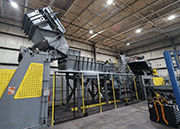
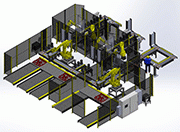
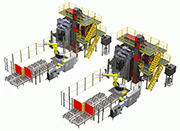
(!) G. E.: An existing customer recently approached BCT to design an integrated blast, inspection, and grind solution. The process begins with eight (8) castings being loaded onto custom-designed manganese steel pallets that are staged on roll conveyors. As full pallets are loaded, they are conveyed forward to a FANUC® robot that picks the fully loaded. pallet and sequentially places two pallets in a custom-designed spinner carousel blast system with four 30 HP M3A blast wheels and a 48” × 60” work opening. As the carousel indexes forward to the blast position, the robot can unload two complete pallets and load the next two.
After blasting, the fully loaded pallets are conveyed to a FANUC depalletizing robot that uses a FANUC vision system to locate the individual castings and place them on a secondary conveyor system. This system also uses a camera system to completely scan the parts and locate any defects that exceed the customer’s defect specifications. The castings are then conveyed to two independent grind stations where a servo-controlled ballscrew with a pneumatic gripper and rotary actuator lifts and rotates the casting to allow the four FANUC robots with an electric force compliance module and servo grinder to correct the defects. The two grind station streams are then reunited at a final FANUC palletizing robot that stacks the finished castings in customer totes for further post-processing.
The result is a 100% hands-off system from shot blasting through inspection and grinding, resulting in parts staged and ready for post-processing.
(?) MFN: As automation becomes more integrated into shot blasting operations, how does BCT coordinate equipment design, controls, and material handling to deliver a complete system solution?
(!) G. E.: The first step in the design process is for the BCT applications team to gain a full understanding of the customer’s process and goals. This frequently includes site visits to review the current process and take measurements of existing facilities or equipment constraints. Oftentimes, we can provide solution options based on other similar situations that the customer may not have been aware of. During these conversations, we strive to expand the focus of the project to the system as a whole, and not just a specific blast machine. This broad focus is what prompted us to continue to expand our controls capabilities and bring automation expertise in-house to keep up with customer demand.
(?) MFN: Are BCT’s automation and controls solutions developed in-house, or does BCT collaborate with outside suppliers for specific components or specialized technologies?
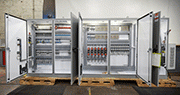
(!) G. E.: We take a multi-pronged approach to meeting customer needs. All control solutions are handled internally, both for PLCs (Allen-Bradley® Gold Vendor and Siemens software) and robotic programming (FANUC).
For application-specific needs, we also rely on supplier expertise to help identify the right solution. FANUC has played an important role in selecting robots based on payload and duty cycle requirements. We have also conducted onsite and independent testing to confirm that camera systems can detect defects to customer standards, and we work closely with tooling and grinding consumable specialists to support robotic grinding applications, especially for challenging materials such as high-chrome white iron used in shot blast liners.
(?) MFN: How do BCT’s controls, automation, design, and engineering teams work together to ensure each system is fully integrated and performs as intended?
(!) G. E.: The key is to have all teams involved in the full system design from the beginning. Our design process is built around a standard sequence with checklists and feedback loops to ensure that each team can review the system and offer input. If each department were to complete its tasks in a vacuum, it would be very difficult to create a seamless, integrated end product for the customer.
(?) MFN: What key factors are driving manufacturers to invest more in automation for shot blasting and related upstream or downstream processes?
(!) G. E.: Manufacturers are investing in automation to address workforce challenges, including an aging skilled labor base and persistent difficulty filling repetitive, physically demanding roles in material handling, loading, unloading, and part movement.
At the same time, customers are demanding higher throughput, tighter quality standards, shorter lead times, and greater consistency. Automated blasting cells and integrated handling systems help manufacturers improve productivity, reduce variation, and support better process control.
Automation also supports employee retention by removing some of the most repetitive, dirty, and ergonomically challenging tasks, allowing workers to focus on higher-value activities such as quality control, process optimization, and equipment oversight.
Ultimately, automation is not just about reducing labor costs. It helps manufacturers improve consistency, increase throughput, strengthen safety, and build a more sustainable operation for the future.
(?) MFN: What should manufacturers consider when planning an automated shot blast system installation to help ensure a successful project, from defining the scope and involving the right teams to coordinating upstream and downstream processes?
(!) G. E.: A successful automated shot blast installation starts with treating automation as a complete production system, not just a standalone blast machine.
Manufacturers should involve the right teams early, including operations, production, maintenance, engineering, quality, safety, IT, and management. Early input helps define the scope clearly and identify potential issues before they become costly changes. It is also important to evaluate upstream and downstream processes, including how parts arrive, how they are presented for blasting, and what happens after blasting. Loading, unloading, inspection, packaging, painting, and other secondary operations can create bottlenecks if they are not considered upfront.
IT should also be included early, since modern systems often require network connectivity for monitoring, diagnostics, maintenance tracking, ERP integration, and cybersecurity requirements.
Manufacturers should also plan for future growth by considering added capacity, new part families, additional automation, or future process integration within the layout, controls, and material handling design.
With a clear scope, cross-functional collaboration, careful process planning, and a long-term view, manufacturers are better positioned for smoother implementation and a stronger return on investment.
(?) MFN: For manufacturers rebuilding or upgrading existing blast machines, can BCT add modern controls, automation features, or material improvements to current equipment designs?
(!) G. E.: Absolutely. "That’s the way we’ve always done it" isn’t a reason not to make improvements and modernize equipment or a facility. For controls upgrades, we always perform a site visit because, as we all know, existing equipment has inevitably been modified from the original specifications. This allows our electrical team to verify the current condition of components and document the current sequence of operations to replicate or modify. From there, we can tailor a solution that meets the customer’s needs.
When addressing material handling solutions, one of the more common upgrades is the in-kind replacement of loaders and conveyors. A specific example would be replacing a cable-actuated tumble blast loader with a modern hydraulically operated loader. This system is safer, more compact, and easier to maintain.
Oftentimes, upgrades can be made using a phased approach to minimize downtime and meet a customer’s budgeting requirements. For example, on a recent large bridge girder machine, a three-phase approach was used to address the most critical areas first and successively improve the operation. Phase 1 was a reclaim system upgrade with new augers, elevators, and separators. Phase 2 was a full cabinet reline, new blast wheels, and a complete control system replacement. Phase 3 was extended vestibules with pivoting finger seals to improve shot retention and access.
(?) MFN: Does BCT manage installation through its own Technical Services Team, and how is the installation process planned, coordinated, and supported from start to finish?
(!) G. E.: Each project is managed from beginning to end by a dedicated project manager who is responsible for overseeing the schedule and communicating directly with the customer. The installation schedule is one of the first items to be reviewed, as oftentimes the customer is working around a planned shutdown or has a tight window to complete installation without affecting production. This allows the design process to account for any installation-specific requirements. BCT utilizes our nationwide service team to handle the installation and will bring in additional contractors as required to meet timeline and manpower requirements. Note that every installation, every shift, will always be led by a BCT-certified service technician—we never put the success of a project in a contractor’s hands. In addition to our dedicated service crew, we also utilize resources from our manufacturing facility, with assemblers and welders often assisting onsite as required.
Mechanical and electrical engineering resources are available throughout the installation and will be onsite as required for each individual project. Programming support is also available on an ongoing basis through a remote connection, depending on customer IT permissions.
(?) MFN: BCT has the capability to support processes before, during, and after shot blasting. Can you explain how BCT works with complementary systems that feed, support, or integrate with the blast system?
(!) G. E.: The key to success is clear and open communication with the customer, associated vendors, and system integrators. All designs are 3D-modeled in SolidWorks, and we’re also able to incorporate facility layouts or adjacent equipment to show how they will interact. On the automation and robotics side, we can utilize Emulate3D to fully simulate robotic range of motion and material flow. This ensures seamless handoffs between all components of a system.
MFN would like to thank Greg Ernest for this interview!
For Information:
Blast Cleaning Technologies
6682 W. Greenfield Ave., West Allis, WI 53214, USA
Tel. +1.262.785.7577
E-mail: sales@bct-us.com
www.bct-us.com




 BACK
BACK