
E-Archive
 BACK
BACK
Articles
in Vol. 27 - September Issue - Year 2026
Shot Peening: Precision Surface Engineering for Fatigue Performance and Process Stability

Shot peening

Ervin Amapeen peening shot

Shot-peened coil springs
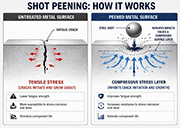
Shot peening process comparison

Shot peening before and after appearance

Shot peening before-and-after structure
Why media quality, AMS compliance, and process control are becoming increasingly critical in modern shot peening applications.
In demanding engineering sectors such as aerospace, motorsport, automotive, and medical manufacturing, component performance is increasingly defined not only by material selection and design, but also by surface integrity.
As manufacturers continue to push for lighter, stronger, and longer-lasting components, fatigue resistance has become a major focus of modern engineering. In many cases, the greatest weakness in a component is not buried deep within the material; it begins at the surface.
This is where shot peening plays a vital role.
Unlike conventional abrasive blasting, which focuses primarily on cleaning or surface preparation, shot peening is a highly controlled mechanical process designed specifically to enhance the fatigue performance of metal components. Through the repeated impact of precisely engineered spherical media, beneficial compressive residual stresses are introduced into the surface layer of a component, significantly improving resistance to crack initiation and propagation.
For industries where reliability and durability are critical, shot peening is no longer simply a finishing operation. It is an essential engineering process.
The Science Behind Shot Peening
The principle behind shot peening is straightforward, yet highly effective.
Small spherical metallic particles are accelerated at high velocity toward a component surface. Each impact creates a microscopic indentation, plastically deforming the outer surface layer. As millions of impacts overlap, they generate a uniform compressive stress layer across the surface.
This compressive layer is critically important because most fatigue cracks initiate at or near the surface of a component under tensile loading conditions. By placing the surface into compression, shot peening makes it significantly more difficult for cracks to initiate and grow.
The benefits can include:
• Increased fatigue life
• Improved resistance to stress corrosion cracking
• Greater resistance to fretting fatigue
• Enhanced durability under cyclic loading
• Improved reliability of highly stressed components
As a result, shot peening is widely used on:
• Aerospace structures and turbine components
• Automotive springs and gears
• Crankshafts and connecting rods
• Driveline and transmission components
• Motorsport components
• Medical implants and precision-engineered parts
In many respects, shot peening can be thought of as a controlled conditioning process for metal surfaces, strengthening the component precisely where fatigue failures are most likely to begin.
Why Consistency Matters
While the concept of shot peening may appear simple, achieving repeatable and reliable results requires extremely tight process control.
Successful peening is not about blasting harder. It is about delivering the correct impact energy consistently across the entire component surface. Variables such as media size, hardness, velocity, coverage, exposure time, and impact angle must all be carefully controlled.
Among these factors, the quality and consistency of the peening media itself are among the most critical.
If shot media varies excessively in size, hardness, or roundness, the energy transferred during each impact also varies. Some particles may strike too aggressively, while others may not deliver sufficient energy. Over time, this can result in unstable Almen intensity, inconsistent coverage, excessive dust generation, increased machine wear, and unpredictable process performance.
For manufacturers working in highly controlled sectors such as aerospace and motorsport, this level of variability is unacceptable.
The Importance of AMS Specifications
To ensure process consistency, many industries, particularly aerospace, specify shot media manufactured to stringent AMS standards.
AMS specifications define strict tolerances for:
• Particle size distribution
• Hardness
• Chemical composition
• Durability
• Roundness and condition
The objective is to ensure that every particle behaves predictably during the peening process, allowing manufacturers to achieve consistent peening intensity and repeatable compressive stress profiles.
Even outside aerospace, the advantages of AMS-compliant media are increasingly recognised. Automotive, energy, motorsport, and precision engineering manufacturers are all under pressure to improve reliability while maintaining process efficiency and reducing operational costs.
In these applications, media consistency contributes not only to fatigue performance, but also to overall production stability.
Ervin Europe's Approach to Shot Peening
As a specialist in metallic abrasives and peening media, Ervin has developed a range of products specifically engineered for demanding shot peening applications.
The company’s peening solutions are designed to support stable, repeatable processes while helping manufacturers optimise efficiency and reduce waste.
Its premium cast steel peening shot, Amapeen, is produced to meet relevant AMS shot specifications and is manufactured under tightly controlled conditions to ensure consistent hardness, size distribution, and roundness.
For users, this consistency can deliver:
• Stable Almen intensity
• Predictable coverage
• Reduced media breakdown
• Lower dust generation
• Improved process repeatability
• Longer media life
In addition to Amapeen, Ervin also supplies Amacast and Amachrome stainless steel shot for specialist blasting and peening applications.
These stainless steel shot products are particularly suited to applications where ferrous contamination must be avoided, including stainless steel processing and specialist surface engineering operations.
Case Study: Reducing Peening Media Wastage in High-Precision Manufacturing
One UK surface preparation company specialising in aerospace, automotive, motorsport, and medical applications recently faced a significant challenge with media wastage in its shot peening operation.
The company supplies highly demanding customers, including Formula One teams and major aerospace manufacturers, using specialist peening equipment designed specifically for precision-engineered components. Some elements of the peening machinery are manufactured in-house to meet the company’s exact process requirements.
However, despite operating sophisticated equipment, the company was experiencing extremely high abrasive wastage levels using peening shot supplied by another manufacturer.
Before use, large quantities of fractured or misshaped particles were being removed through reclassification based on the specification for in-process media (AMS2430). In some cases, up to 35% of the new peening shot was discarded before use, resulting in excessive abrasive consumption, substantial costs to recycle the discarded shot into low-grade steel, and increased labour required to reclassify the new shot.
Working closely with the customer, Ervin analysed both the supplied media specification and the customer’s in-process specification, with particular focus on the parameters for roundness, joined particles, clusters, and cracked particles.
Following detailed technical discussions, Ervin developed a customised peening shot specifically engineered to meet the customer’s in-use specification. Initial trials delivered immediate improvements.
Testing showed that wastage levels could potentially be reduced from 35% to approximately 10%, dramatically reducing abrasive consumption and associated disposal costs.
The customer then challenged Ervin further by requesting an even tighter sizing distribution than the standard AMS specification.
After collaboration between the customer and Ervin’s manufacturing team, this enhanced specification was successfully achieved, delivering even greater process efficiency and improved operating stability.
The customised media was subsequently approved for full production use, with ongoing monitoring consistently confirming wastage levels at or below the predicted 10% target.
According to the customer’s Facilities Maintenance Manager:
"The customised peening shot that Ervin developed for us has improved our peening process and saved us considerable wastage and cost. We believe that some of our competitors may be conditioning the media to shatter the shot containing internal defects, which could incur even higher costs."
Adam Twose, UK Sales Manager at Ervin Europe, commented:
"We listened carefully to what the customer was asking for and worked with them to develop and test our solution."
Looking Beyond Initial Media Cost
In many shot peening operations, purchasing decisions are still heavily influenced by the initial cost of media. However, experienced operators increasingly recognise that total process efficiency is far more important than the price per tonne alone.
Lower-quality media often breaks down more rapidly, generating excessive fines and dust while requiring more frequent replenishment. This can negatively affect separator efficiency, machine wear, maintenance intervals, and overall process consistency.
By contrast, premium peening media engineered for durability and consistency can help deliver:
• Reduced abrasive consumption
• Lower waste disposal costs
• Improved machine efficiency
• More predictable production performance
• Reduced downtime
• Enhanced process stability
For high-throughput manufacturing operations, these operational savings can significantly outweigh any difference in initial media purchase price.
Precision Surface Engineering for Modern Manufacturing
As engineering demands continue to increase across aerospace, automotive, motorsport, and other high-performance sectors, the importance of tightly controlled surface engineering processes will only continue to grow.
Shot peening has evolved far beyond a simple blasting operation. Today, it is a precision-controlled enhancement process that plays a critical role in extending component life and improving fatigue performance.
As many manufacturers are discovering, achieving consistent results depends heavily on the quality and stability of the media itself.
For companies seeking improved fatigue performance, reduced process variability, and greater operational efficiency, investment in high-specification peening media is becoming an increasingly strategic decision rather than simply a consumables purchase.
For Information:
Ervin Germany GmbH
Rudower Chaussee 48
12489 Berlin, Germany
Tel. +49.30.400 37846
E-mail: info@ervin.eu
www.ervin.eu