
E-Archive
 BACK
BACK
Good Vibrations
in Vol. 27 - September Issue - Year 2026
Education & Mass Finishing

Slide #1 – Part X: Software Model

Slide #2 – CNC Machining Center

3D DMLS Printer

Slide #3 – Part X: Finished Production

Print of original part design
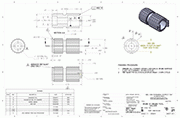
Print of corrected part design

Formula 1 racing engine valves
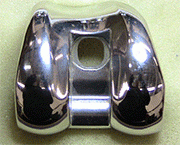
Femoral implants
An auditorium is filled with mechanical engineering students in the final years of their studies. The presentation introduces them to the art of mass finishing and highlights the significant role it plays in component manufacturing across a wide range of industries, from aerospace and medical applications to jewelry manufacturing.
The students are asked: "How many of you know how to use CAD software to model this component and subsequently create a part drawing?" Nearly 100% raise their hands.
The students are then asked: "How many of you know how to transfer data from design software to a CNC machine or 3D printer to manufacture the part?" Only 60% raise their hands.
The students are then asked: "How many of you recognize, at the beginning of the design process, that 72 features on this machined part could prevent it from functioning as required?" No hands are raised, and the students look perplexed.
Current Situation:
The part would not fit into its mating component within the designed assembly because of burrs around the spline features. The mating component would also fail to engage properly due to burrs on the cross-machined slot. In addition, the functional requirements of the sliding spline surfaces had not been taken into consideration.
After the part has gone through production and becomes the subject of corrective action from the assembly department, feedback is sent back to engineering so that the necessary specifications can be added to the drawing.
The following specifications should be included on component part drawings to support more effective manufacturing:
1. All edge-break requirements
2. All surface requirements, including any specified exceptions
3. Visual requirements describing the desired surface appearance, for which few recognized standards exist, such as high-gloss, dull, or matte finishes, or the removal of machining marks
4. A validated finishing process that may specify the machine, media, compound, and cycle time
Real-World Examples
A more detailed part drawing with comprehensive finishing specifications can make the manufacturing process more effective and efficient, as demonstrated by the previous component.
Surface-finishing improvements can also enhance a part’s functionality and overall performance.
These F-1 engine valves last longer and operate at lower temperatures due to the surface finish specified on the drawing—a requirement developed through extensive testing and feedback. The drawing originally called for an "as-ground" finish; it now specifies a clearly defined surface-finish requirement.
The original femoral implant drawing included an Ra surface roughness specification. Although the finishing operation met this requirement, the finish was rejected for aesthetic reasons. The customer—in this case, the doctor—perceives the part as having a higher-quality finish when the reflection of the inspection light is clearly visible under 10× magnification. This visual requirement is now specified on the drawing in addition to the Ra value.
Surface-finishing callouts on drawings give manufacturers a clearer understanding of the expected outcome.
Surface-finishing improvements can increase a part’s value to the customer.
Education Buy-In
This magazine has promoted surface finishing—the "back end" of manufacturing—for many years, yet engineering education has not given it the same level of attention. Surface finishing needs to become an integral part of engineering curricula. Engineers must understand these requirements and incorporate the appropriate specifications into their designs from the very beginning.
From the outset of a design project, engineering students should understand not only the part’s intended function but also the importance of consulting with assembly and manufacturing teams so that potential issues can be identified and addressed early in the process. Students must be taught that manufacturing has a "back end."
Good Vibrations
by Steve Alviti Sr
Contributing Editor MFN and
President and Owner of Bel Air Finishing Supply Corporation
E-mail: salviti@belairfinishing.com