Vixen Surface Treatments is leading a major transformation in surface preparation as global manufacturers increasingly replace traditional dry blasting with advanced wet blasting technology. In this exclusive interview, MFN was able to speak with Vixen Export Sales Manager Chris Owen. We explore why high-precision industries are making the shift, how Vixen is redefining aerospace and MRO operations with compact solutions, and why the company’s 100% in-house manufacturing and multi-technology integration provide unmatched security for tier-one manufacturers worldwide.
(?) MFN: The title of your recent article highlights a global shift toward wet blasting. What is driving manufacturers to move away from traditional dry blasting methods?
(!) C. O.: The shift is primarily driven by four critical factors: precision, component longevity, workplace safety, and added value and resources. Other technologies, such as dry blasting or chemical processes, rely on high-impact velocity or harsh, dangerous substances to chip away at surface contaminants. While this brute force is effective on robust structures, it is far too aggressive for today’s high-precision engineering components, not to mention the health and safety concerns around those methods some of the time. Dry blasting frequently alters critical dimensions, creates unwanted surface stress, and leaves embedded abrasive particles trapped within the substrate, whilst chemical processes can be inherently dangerous but also expensive, both initially and on an ongoing basis, with additional environmental costs.
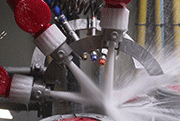
Wet blasting, on the other hand, introduces water into the mix to create a finely controlled slurry. The water acts as both a lubricant and a protective cushion. Instead of a harsh, fracturing impact, the process relies on the hydraulic flow of the water-abrasive slurry to wash away contaminants and smooth the surface. This entirely eliminates media embedment, preserves the strict structural integrity of the part, and creates a much finer, more consistent, repeatable, and highly controllable finish.
Beyond the technical performance on the component, there is a massive health and safety driver. The water completely suppresses airborne dust, meaning a cleaner environment and no static build-up. This drastically improves the factory floor environment, eliminates the risk of respiratory hazards for operators, and aligns perfectly with stringent global health and safety regulations.
(?) MFN: It is common to see wet blasting categorised simply as a cleaning method. Can you clarify why this is a misconception?
(!) C. O.: This is a vital point to clarify. Wet blasting is fundamentally a highly sophisticated surface preparation and finishing process, not just a cleaning method. While it does clean components exceptionally well by removing oxides, scales, and carbon deposits, its primary value lies in its ability to condition a surface to exact engineering specifications.
For example, when a manufacturer needs to prepare a surface for subsequent coatings, bonding, or non-destructive testing (NDT), the wet blast process creates an ideal, uniform surface topography. It produces a controlled, microscopic "satin" etch that vastly improves coating adhesion without compromising the underlying dimensions. It is also widely used for cosmetic finishing, deburring, and reducing surface roughness (Ra values) on complex machined components. Describing it merely as "cleaning" completely undervalues the metallurgical and surface-engineering benefits it delivers.
(?) MFN: Vixen Surface Treatments works across a massive variety of sectors. Which key industries are driving this transition, and what specific applications do you cover?
(!) C. O.: We partner with high-precision, high-stakes sectors worldwide where component failure is simply not an option. Our core sectors include:
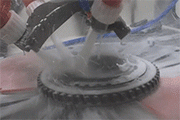
• Aerospace OEM & MRO: This is a consistently growing area, from surface preparation on new components for deburring, coating prep, and surface quality to MRO shops and facilities overhauling engines, cleaning fir tree slots, and removing paint from wheels, all as part of NDT procedures.
• Automotive & Motorsport: From remanufacturing gearboxes and engines to preparing high-performance components for racing, wet blasting provides an immaculate, chemically clean surface finish ready for inspection, coating, or rebuilding.
• Medical Technology: Implants, surgical instruments, and prosthetics require ultra-clean, uniform finishes. Wet blasting offers the exact repeatability and sterile-capable processing needed for medical-grade components.
• Tooling & Die Manufacturing: Extrusion dies, moulds, and cutting tools benefit immensely. The process cleans complex geometries and removes heat-treatment scale without rounding sharp edges or damaging critical profiles.
• Electronics & Semiconductors: We handle delicate cleaning, deflashing, and surface etching of electronic enclosures and semiconductor components where static control, gentle processing, and extreme cleanliness are paramount.
• Overhaul & Refurbishment Operations: Across heavy plant, rail, and marine sectors, we provide complete cleaning solutions designed to remove heavy, stubborn contaminants. We automate what have traditionally been highly laborious, manual cleaning tasks, transforming them into fast, efficient, and repeatable automated processes.
(?) MFN: Let’s focus on the Aerospace and MRO (Maintenance, Repair, and Overhaul) sector. Why is the wet blast process becoming mandatory here, and how does Vixen support these operations?
(!) C. O.: Aerospace MRO is perhaps the most demanding application environment in the world. When you are overhauling an aircraft engine component, a landing gear assembly, or a turbine blade, the margins for error are zero. These parts suffer from severe carbon buildup, baked-on oils, and environmental erosion. However, you cannot risk removing any parent metal during the refurbishment process.
Our world-leading wet blast technology is crucial here because it removes these aggressive deposits while preserving the component’s strict original tolerances. Furthermore, it leaves a perfectly uniform, smut-free surface that is absolutely ideal for fluorescent penetrant inspection (FPI) and other non-destructive testing methods. If a surface has dry-blasted media embedded in it, it can easily mask a micro-crack, leading to catastrophic failure. Wet blasting eliminates that risk entirely.
What brings our aerospace partners back to us time and time again is the high accuracy, repeatability, and consistency that the Vixen process offers. When a process is validated for an aerospace component, it must deliver the exact same surface finish every single time, whether it is the first part of the day or the thousandth. Our control systems guarantee that consistency.
(?) MFN: Aerospace facilities and MRO workshops often face severe space constraints. What compact solutions has Vixen developed to address this challenge?
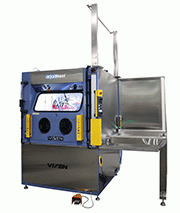
(!) C. O.: We listened closely to our aerospace and MRO clients who loved our technology but needed a smaller footprint that could sit directly within lean manufacturing cells or busy maintenance depots. In response, we developed our specialised range of compact MRO solutions, led by the Aquablast® 1215 Compact and the MRO Cube Compact.
The Aquablast® 1215 Compact packs all the punch, durability, and advanced filtration of our larger industrial units into a highly streamlined, ergonomically optimised footprint. It is engineered specifically for workshops where floor space is at a premium but high-quality manual wet blasting cannot be compromised.
The MRO Cube Compact is an incredible piece of engineering designed for larger, heavier MRO components that still require a space-conscious housing. It features a heavy-duty, reinforced build capable of handling substantial weights, often paired with internal turntables for ease of component handling. These compact machines allow aerospace workshops to integrate premier surface finishing directly into their workflow, eliminating the need to transport parts across massive facility footprints.
(?) MFN: What truly makes Vixen unique in the global surface treatment market? Many companies only specialise in a single technology.
(!) C. O.: What really sets us apart—and makes us unique in the industry—is our ability to act as a complete solution provider and integrator, rather than just a machinery manufacturer. While we are globally recognised as the leading wet blasting company in the world, we also possess market-leading expertise in a variety of other critical cleaning technologies.
For complex overhaul and refurbishment operations, we combine our wet blast technology with our advanced aqueous washing, heavy-duty degreasing, and precision ultrasonic solutions.
Many customers initially enquire about a single solution or a specific process because that is what they are accustomed to. However, when we sit down and consult with them, we look at their entire production line. Because we possess all of these leading technologies under one roof, we can work together to provide the ultimate solution. This frequently means consolidating multiple separate process steps into a single, seamless solution and process step. By doing this, we save our partners immense amounts of time and resources, reduce floor space requirements, minimise part handling, and add massive value to their operations.
(?) MFN: You place a strong emphasis on "supplying solutions, not just machines." What does that partnership approach look like in practice?
(!) C. O.: We don't believe in transactional relationships where a machine is simply crated up and shipped out. We partner with our customers from day one. When a manufacturer approaches us, they are usually trying to solve a specific production bottleneck, surface finish issue, or quality control challenge.
Our approach involves working hand-in-hand with their engineering teams. We utilise our extensive in-house testing laboratories, encouraging clients to send us actual production samples. Our technicians run exhaustive trials—testing different media types, slurry concentrations, pressures, and cycle times—to develop the absolutely perfect "recipe" for their specific application. We provide detailed surface roughness reports and process validation before a single piece of steel is cut for their machine. We supply the complete engineering solution, including automated handling, system integration, and tailored chemistry.
(?) MFN: One of Vixen’s major talking points is your manufacturing model. Why is it a significant advantage that you manufacture 100% of your equipment in-house?
(!) C. O.: This is arguably our greatest competitive advantage and a massive security benefit for our clients. We manufacture 100% of our equipment in-house at our state-of-the-art production facility. From the initial 3D CAD design and PLC software programming to laser cutting, stainless steel fabrication, electrical control panel assembly, and final testing, everything is controlled directly by Vixen.
Many of our competitors in the surface treatment market operate as assembly shops or outsource their fabrication to third-party suppliers, sometimes even overseas. When a supplier outsources, they lose direct control over quality, material integrity, and lead times. If a design modification is needed, it becomes a slow, bureaucratic process.
Because we control our entire process from start to finish, we offer global manufacturers total security. They know exactly who engineered their system, they can audit our facility at any time, and they have a single point of accountability. If they need support or custom modifications five years down the line, our in-house engineering team has the exact schematics and software code ready to deploy.
(?) MFN: Vixen has a major footprint in the UK, but your article title specifically mentions "Global Manufacturers." Can you speak to your international reach and capabilities?
(!) C. O.: While we are incredibly proud of our British manufacturing heritage, Vixen is a truly global operation. We have built an extensive international network that allows us to support manufacturers anywhere in the world. Whether a company is installing a standalone Aquablast® cabinet in Europe or integrating a fully automated, multi-stage robotic wet blasting line in North America or Asia, Vixen provides the same seamless level of service. Our global reach ensures that installation, commissioning, operator training, and ongoing technical consultancy are delivered locally, keeping our partners' production lines running efficiently no matter where they are located. We also have global test lab locations to support our customers worldwide and give them confidence that Vixen is the right partner.
MFN would like to thank Chris Owen for this interview!
For Information:
Vixen surface treatments ltd
73 Jay Avenue, Teesside Industrial Estate
Thornaby, Stockton on Tees
Ts17 9LZ, England
E-mail: chris.owen@vixen.co.uk
www.vixenaquablast.com




 BACK