From watch components measuring only a few millimeters to battery trays several meters in size, the range of parts to be cleaned and the cleanliness specifications to be met have never been greater. At the same time, manufacturers have individual requirements in terms of throughput and automation, while sustainability is becoming increasingly important. MFN spoke with Oliver Pelz, Sales Director at Ecoclean in Filderstadt, Germany, about the factors that determine the right cleaning solution and how flexible system, process, and drying technologies can meet this growing diversity of requirements.
(?) MFN: Mr. Pelz, why is industrial parts cleaning becoming more demanding?
(!) O. P.: The manufacturing industry is undergoing a transformation. Sectors such as zero-emission mobility, electronics, artificial intelligence, sensor technology, and aerospace are becoming growth drivers, while lightweight construction continues to gain in importance. As a result, products and production volumes are changing. Components are becoming more delicate and complex on the one hand, while on the other hand, their dimensions now range from just a few millimeters to several meters. The variety of materials is also increasing. In addition, there is a wide range of product-specific and customer-specific requirements for particulate and film-type cleanliness. Meeting these specifications cost-efficiently and with low energy and resource consumption is another essential requirement. More and more often, cleaning also needs to be automated, integrated into production lines, and intelligently controlled.
(?) MFN: Interesting. With such a broad spectrum of requirements, what needs to be considered when selecting an optimal cleaning solution?
(!) O. P.: The required cleanliness is only one factor. The type and quantity of contamination to be removed, as well as the material, geometry, dimensions, and weight of the component, are equally important. Company-specific criteria must also be taken into account, including throughput requirements, the investment budget, automation, and digitalization. This calls for a supplier whose product portfolio offers the necessary flexibility in terms of cleaning media, system technology, and process technology. The aim is not to select a machine in isolation but to configure a solution that matches the complete cleaning task and the individual production environment.
(?) MFN: Can you tell us how Ecoclean covers this broad variety of cleaning tasks and specifications?
(!) O. P.: As a full-range supplier of forward-looking as well as energy-efficient solutions for industrial parts cleaning, surface treatment, and automation, Ecoclean covers the entire spectrum of wet-chemical processes. This includes water-based media, solvents, and modified alcohols. The portfolio comprises standard machines, module-based systems for chamber, continuous, and multi-stage immersion processes, as well as special-purpose systems designed for specific applications. This broad range gives us the flexibility to adapt the cleaning solution to the component, the contamination, the required result, and the customer’s production requirements.
(?) MFN: Which process technologies are available within this portfolio?
(!) O. P.: Depending on the application, technologies such as spray cleaning, high-pressure cleaning, immersion cleaning, ultrasonic cleaning, plasma cleaning, vapor degreasing, injection flood washing, Pulsated Pressure Cleaning (PPC), and Ultrasound or Ultrasound Plus can be implemented. Applied to the specific task, these processes ensure that the required cleanliness specifications are achieved reliably, reproducibly, and resource-efficiently. Process design is carried out in Ecoclean’s own Test Centers. This is important because it allows the cleaning process to be matched precisely to the actual requirements rather than relying on a generalized solution.
(?) MFN: Does this flexibility apply to both batch cleaning and single-piece cleaning?
(!) O. P.: Yes. The versatility of our system, process, and drying technologies makes it possible to tailor cleaning solutions efficiently to company-specific requirements for both batch and single-piece cleaning. If required, the solution can also be automated. For batch cleaning, single-chamber and multi-chamber systems operating under full vacuum are available with either water-based media or solvents. The appropriate configuration always depends on the cleaning task, the required capacity, and the conditions in the customer’s production process.
(?) MFN: Let’s look at some examples. Are there references covering the range of parts mentioned at the beginning of our interview? What about a cost-efficient solution for lower capacities?
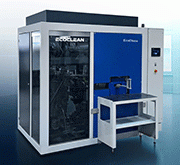
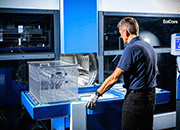
(!) O. P.: Where the volume of parts to be cleaned is relatively low, the space-saving EcoCbase, for example, provides a cost-efficient entry into solvent cleaning. Operating under full vacuum, it removes oils, greases, emulsions, and chips reliably using either a hydrocarbon or a modified alcohol. The compact plug-and-play system can be adapted flexibly to different applications, from pre-cleaning and intermediate cleaning to final cleaning. New heat recovery functions reduce energy consumption and contribute to low operating costs. This example shows how a standardized system can still be configured for different cleaning stages and economic requirements.
(?) MFN: Thank you. Is there also an example involving components with high cleanliness requirements and specific production needs?
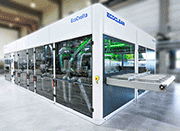
(!) O. P.: Yes, certainly. A good example is the cleaning of components for electromobility. These are usually sensitive parts with high cleanliness requirements that must be cleaned at high speed. This is where the continuously operating EcoCvolta can demonstrate its strengths. The modular belt conveyor system allows different process technologies to be used, including high-pressure and low-pressure spraying, steam cleaning, hydro cleaning, plasma cleaning, CO2 snow blasting, and laser cleaning. Different drying processes can also be integrated. The modular concept therefore provides the flexibility required to configure the line for the relevant component and process sequence.
(?) MFN: Is there a concrete production example for the EcoCvolta?
(!) O. P.: Absolutely. The solution is used in the high-volume production lines of a manufacturer of battery cell housings made of steel and aluminum, measuring 254 by 126 by 32 millimeters. Robots load the systems in six lanes from trays, which are also cleaned in the system. The housings are first specifically deburred and cleaned at 300 bar. This is followed by a two-stage rinsing process with deionized water and hot-air drying. Before the robots return the housings to the trays, they pass through a vacuum dryer for internal and external drying and finally undergo a leak test. The example illustrates how cleaning, drying, handling, and testing can be combined in an automated production sequence.
(?) MFN: What happens when a cleaning task cannot be solved with a standard machine or a modified modular system?
(!) O. P.: In that case, an individually designed special-purpose system is required. One example is a solvent-based cleaning system that an original equipment manufacturer of battery systems has integrated into the production line for cleaning battery trays. The components are around 1.20 meters in size. Their handling, as well as loading and unloading, is also automated. This application demonstrates that the same fundamental selection criteria apply even when dimensions and handling requirements move beyond the scope of standard or modified modular systems.
(?) MFN: How does Ecoclean actually design the process? How do you find the right solution for the respective cleaning task?
(!) O. P.: The process design is carried out in our own Test Centers. Within the overall selection process, this ensures that the combination of cleaning medium, system technology, process technology, and drying technology is aligned with the actual application. The relevant factors include the contamination to be removed, the component material and geometry, its dimensions and weight, and the stipulated particulate and film-type cleanliness. Throughput, investment, automation, and digitalization requirements are also part of the assessment. In this way, the selected process can be designed to achieve the required cleanliness reliably, reproducibly, and resource-efficiently.
(?) MFN: One last question, Mr. Pelz: What is the central message for manufacturers facing new or changing cleaning requirements?
(!) O. P.: The diversity of components, materials, contamination, cleanliness specifications, production volumes, and automation requirements means that there is no single solution for every task. What is needed is the ability to select and combine the appropriate cleaning medium, system concept, process technology, and drying technology. Ecoclean provides this range with standard machines, modular systems, and individually designed special-purpose systems. In our own Test Centers, the process is designed for the respective application. This makes it possible to achieve the specified cleanliness reliably and reproducibly while also addressing cost efficiency, energy and resource consumption, throughput, automation, and integration into the production line.
MFN would like to thank Oliver Pelz for this interview!
For Information:
Ecoclean GmbH
Oliver Pelz, Director Sales
Muehlenstrasse 12, 70794 Filderstadt, Germany
Tel. +49.711.7006-0
E-mail: oliver.pelz@ecoclean-group.net
www.ecoclean-group.net




 BACK