Media lodging is usually treated as a separation problem, but it begins much earlier, when media is selected without fully mapping the part geometry. A geometry-led screening method can reduce trapped media while preserving access to the surfaces that need finishing.
Media lodging can turn an otherwise successful mass finishing process into a production problem. A part may leave the machine with the required edge condition and surface appearance, yet still carry media in a hole, slot, or recessed feature. Removing that media adds labour, complicates inspection, and creates uncertainty about whether every part is clear.
The practical answer is not simply to select smaller or larger media. The risk depends on how media size, shape, and orientation interact with the complete geometry of the workpiece. Selection should therefore begin with the part, not the media catalogue.
Map the Restrictive Features
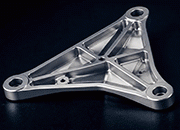
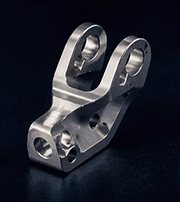
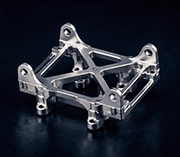
Start by identifying every feature into which media can enter or against which it can bridge. The obvious measurements are hole diameter and slot width, but depth, entry angle, internal steps, and intersections also matter. A through-hole may release media easily, while a blind hole of the same diameter may retain it. Two intersecting holes can create a pocket that does not exist when either feature is considered alone.
The smallest opening is not always the only critical feature. A long slot, a counterbore, a recessed pocket, or the gap between two ribs can present a different lodging mechanism. For each feature, record its minimum opening, depth, and available exit path. A marked drawing or a small set of close-up photographs is often more useful during media selection than a single overall dimension.
This review also clarifies the finishing objective. If a recessed surface does not require contact, media may be deliberately excluded from it. If an internal edge must be deburred, the media must be able to reach that edge and then leave the feature reliably. Access and release are separate requirements.
Consider Shape as Well as Nominal Size
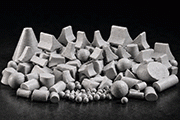
Nominal size alone does not describe how a piece of media behaves. A cone, cylinder, triangle, and sphere with similar catalogue dimensions can enter the same opening in different orientations. Tapered media may reach narrow areas effectively, but that ability can also allow it to wedge. Cylindrical media may align with a bore. Spherical media has no preferred orientation, but it can still become trapped in a pocket or between converging surfaces.
For this reason, compare the media's actual dimensions in every likely orientation with the part feature. The question is not only whether one piece can enter. It is also whether the piece can rotate, sit crosswise, or be driven deeper by the motion of the process.
Media condition must be included in the comparison. Ceramic and plastic media wear during use, so their dimensions and edge profiles change. A selection that is safe when new may become vulnerable after the media has worn. Screening should consider the practical operating range, including the point at which media will be removed or replenished.
Check Single-Piece and Multiple-Piece Lodging
There are at least two common lodging modes. In the first, one piece enters a feature and wedges because of its orientation or the change in section. In the second, two or more pieces bridge across an opening or lock together inside it. A simple clearance check may identify the first risk but miss the second.
A useful bench screen is to place representative media against the actual part, or against a faithful sample of its restrictive features. Try the media in several orientations without forcing it. Then check whether two pieces can enter or bridge together. Repeat the check with media representing different stages of wear if the process will run the media over a long service interval.
This is a screening exercise, not a substitute for a machine trial. It removes clearly unsuitable candidates before production variables such as load movement, part-to-part contact, and compound flow are introduced.
Balance Access with Safe Release
Choosing media that cannot enter any opening may reduce lodging, but it may also leave important internal edges untouched. Conversely, selecting media for maximum access can increase the chance of retention. The correct choice balances the required finish with a reliable exit path.
Where the geometry creates a conflict, it is better to change the process concept than to accept repeated manual clearing. Options may include a different media shape, a staged process, controlled part orientation, masking, fixturing, or a separate operation for the difficult feature. The most appropriate route depends on the part material, edge requirement, surface target, and production volume.
This is why a universal media-to-hole ratio is rarely enough on its own. Such a rule cannot fully describe tapered shapes, intersecting features, worn media, or multiple-piece bridging. It may be useful as an initial filter, but the final decision should be confirmed on the real geometry.
Validate in a Controlled Trial
Once the shortlist is established, run a controlled trial using representative parts and a documented process load. Keep the variables clear: media type and condition, part quantity, machine settings, compound concentration, and trial duration. If several media candidates are being compared, change one main factor at a time.
Inspect at planned intervals rather than waiting only for the final result. Early checks show whether media is beginning to enter or lodge before the full cycle is completed. Record where each retained piece is found, its orientation, and whether it can be removed freely. Photographs and part-location notes make repeated patterns easier to identify.
Evaluation should cover more than retained media. Confirm that the process still achieves the required burr removal, edge radius, or surface condition, and check that the chosen media does not create unwanted rounding or contact damage. A media option is acceptable only when it meets both the finishing target and the release requirement.
Treat Separation as Part of the Process
Even a sound media choice needs effective separation. Screens, magnetic systems, manual inspection, or other separation methods must suit the media, part size, and production flow. However, separation equipment should not be expected to correct a media-part combination that repeatedly wedges inside a feature.
Define a retained-media inspection method as part of the process plan. Critical holes and recesses may require visual inspection, air clearing, gauging, or another validated check. The method should be realistic at production volume and should specify what happens when media is found.
Finally, monitor media wear and replenishment. If dimensions drift into a lodging range, the original trial result no longer represents the working process. Periodic checks of media condition, together with clear replacement limits, help keep the selection valid over time.
A Geometry-Led Selection Method
Preventing media lodging is not a single calculation. It is a sequence: map the restrictive features, compare every likely media orientation, consider new and worn condition, screen for single-piece and multiple-piece lodging, then validate the shortlist in a controlled trial. Separation and inspection complete the system.
This approach does not remove the need for process testing. It makes that testing more focused and gives the finishing team a clearer basis for accepting or rejecting a media choice. When the part geometry leads the selection, the process is more likely to deliver both the required finish and a workpiece that can be released cleanly for the next production stage.
For Information:
Shenzhen KS Lab Finishing Co., Ltd
No. 11-14, Yantian Shuibei Commercial Street
Fenggang Town, Dongguan, China
Tel. +852.9186.8959
E-mail: info@kslabfinishing.com
www.kslabfinishing.com




 BACK