Abstract
In aerospace and precision manufacturing, chemical process parameters and post-plating quality logs are frequently stored in disconnected data silos, forcing engineering and quality teams into reactive troubleshooting. While manufacturing plants increasingly seek to deploy advanced Industry 4.0 predictive algorithms, implementing machine learning models without a statistically validated descriptive baseline often leads to erroneous process control and costly scrap.
This paper presents an industrial-scale Proof of Concept (PoC) focused on Phase 1: establishing a robust descriptive data baseline using raw production and laboratory records from an active 350-gallon electroless nickel (EN) plating bath. Through the integration of daily chemical titrations (nickel concentration and pH), bath usage metrics (metal turnovers – MTO), and substrate-specific rework logs, Statistical Process Control (SPC) charts and frequency analyses were developed.
The empirical results demonstrate a critical process paradox: while standard chemical parameters remained well within nominal specification limits throughout the bath life, defect incidence (predominantly blistering and adhesion failure) escalated significantly starting at the third MTO, reaching a critical inflection point between 3.0 and 4.0 MTOs. Furthermore, aluminum alloys (6061-T6, 7075-T6) exhibited acute vulnerability compared to the higher resilience of carbon steel substrates.
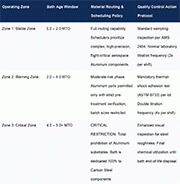
To mitigate this risk, a Three-Zone Operational Management Strategy (Stable: 0–2 MTO, Warning: 2–4 MTO, Critical: >4 MTO) was established, optimizing chemical asset utilization and preventing scrap while providing the mathematical ruleset required for future automated predictive modeling.
Keywords: Electroless Nickel (EN), Statistical Process Control (SPC), Metal Turnovers (MTO), Substrate Sensitivity, Quality 4.0, Aerospace Specifications (AMS 2404, NADCAP AC7108).
1. Introduction & Industrial Background
Electroless Nickel-Phosphorus (EN-P) plating is a widely utilized surface engineering technology across aerospace, defense, and high-precision tooling sectors due to its uniform coating deposition, superior corrosion resistance, high as-plated hardness, and non-line-of-sight coverage capabilities (Sudagar et al., 2013; Parkinson, 2000). Unlike conventional electrolytic plating, EN deposition is governed by a controlled autocatalytic chemical reduction in which nickel cations (Ni²+) are reduced onto catalytic metallic substrates using hypophosphite (H2PO2−) as the primary electron donor (Stapleton, 1995).
To ensure deposit integrity and meet stringent global aerospace specifications—such as SAE AMS 2404, ASTM B733, and NADCAP AC7108 audit criteria—plating facilities must maintain tight operational windows regarding bath temperature, pH, active nickel concentration, and bath age (PRI, 2022; ASTM, 2020; SAE, 2020). Bath aging is universally quantified in terms of Metal Turnovers (MTO), defined as the cumulative replenishment of 100% of the bath's initial dissolved nickel content (Stapleton, 1995).
Despite strict quality mandates, an operational bottleneck persists across many surface finishing facilities: data fragmentation (Salicio-Paz & Hernández, 2021). Laboratory analytical records (pH, temperature, titrations, orthophosphite accumulation) are customarily documented in paper logbooks or isolated departmental spreadsheets. Concurrently, manufacturing traveler cards, part geometries, reject logs, and rework classifications are tracked independently by production and quality assurance personnel. Consequently, engineering teams operate reactively—investigating root causes only after non-conforming parts (displaying blistering, pitting, roughness, or adhesion failures) have already been quarantined (Enache et al., 2023).
While contemporary manufacturing discourse advocates for an immediate transition to Quality 4.0 and predictive Machine Learning (ML) algorithms (Bousdekis et al., 2023), attempting to build predictive models without first establishing a clean, statistically validated descriptive data baseline frequently results in overfitting, algorithmic bias, and costly operational failures. This study addresses Phase 1 of a comprehensive quality transformation: reverse-engineering raw, historical shop-floor logs into an integrated descriptive baseline, establishing empirical substrate-specific control boundaries, and creating the necessary prerequisite framework for future predictive optimization.
2. Methodology & Experimental Setup
2.1 Industrial Environment and Process Architecture
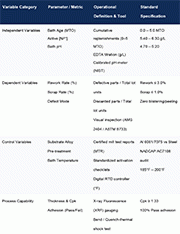
The empirical investigation was conducted within an active aerospace-certified metal finishing facility utilizing a 350-gallon (1,325 L) industrial electroless nickel bath operating with medium-phosphorus chemistry (6–9 wt% P). The operational targets were defined in accordance with technical data sheets and internal standard operating procedures (SOP):
• Active Nickel Concentration: Target = 6.00 g/L (Operating Spec: 5.40–6.30 g/L; Target Control Band: 5.60–6.16 g/L).
• Operating pH: Target = 4.95 (Operating Spec: 4.70–5.20; Target Control Band: 4.76–5.14).
• Operating Temperature: 185–200°F (85–93°C) with continuous mechanical agitation and continuous 1-micron filtration.
• Processed Substrates: Aerospace-grade aluminum alloys (Al 6061-T6 and Al 7075-T6) and engineering carbon steels.
2.2 Data Integration and Control Variables
To isolate the specific effect of bath aging (MTO) and eliminate external confounding noise, standardized operational baselines were enforced across all analyzed production runs. Pre-treatment sequences were strictly executed via NADCAP-compliant checklists: aluminum substrates underwent standard alkaline cleaning, acid deoxidation, and double zincate immersion; steel substrates underwent alkaline degreasing, electrocleaning, and hydrochloric acid activation. Daily titration sheets (performed 2 to 4 times per shift using calibrated instrumentation) were paired with physical traveler logs and digitized into a centralized, structured SQL/tabular data architecture.
3. Results & Empirical Discussion
3.1 The 'Chemical Control Illusion'
Initial statistical evaluation of standard laboratory parameters revealed a critical industrial paradox: the bath appeared to operate in perfect chemical control. Daily active nickel concentrations averaged 5.81 g/L with a standard deviation of 0.14 g/L, fully bounded between the Lower Control Limit (LCL = 5.40 g/L) and Upper Control Limit (UCL = 6.30 g/L). Similarly, bath pH was tightly maintained at 5.08 ± 0.09, well within specification bounds. Under traditional SPC evaluation, quality managers would conclude that the bath is stable and capable of delivering zero defects across all production batches.
However, when these stable chemical logs were cross-referenced with post-plating quality reports, significant defect escalations were identified. In high-turnover baths, standard titrations only measure active reactants and fail to account for the continuous accumulation of reaction by-products—specifically orthophosphite ions (HPO3²−) and sodium counter-ions (Na+). As orthophosphite concentration increases beyond 100–120 g/L, it alters the solution's internal stress profile, reduces deposition rate, and severely elevates substrate interfacial tension (Stapleton, 1995; Sudagar et al., 2013).
3.2 Substrate Divergence: Aluminum Sensitivity vs. Steel Resilience
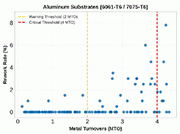
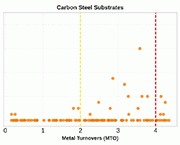
A detailed comparative analysis of substrate types uncovered a profound divergence in defect mechanisms as a function of bath aging. As shown in Figure 1, the rework rate for aluminum components exhibits an exponential-like increase starting at the third MTO, whereas steel components maintain a significantly flatter and more resilient defect trajectory.
For aluminum alloys (Al 6061-T6 and Al 7075-T6), the defect rate remained below 1.0% during the initial life cycle (0 to 2 MTOs). However, beyond 3.0 MTOs, defect incidence rose sharply, reaching peak rework rates between 6.0% and 7.8% (with extreme single-lot reject spikes). The primary non-conformances observed were micro-blistering (gas entrapment) and tape-test adhesion delamination. In contrast, carbon steel components processed in the same aged bath environment exhibited robust tolerance, maintaining an average rework rate below 1.5% and reaching an absolute maximum of 6.0% under extreme bath loading (≥3.6 MTOs).
3.3 Quantitative Defect Distribution by Turnover Intervals
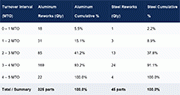
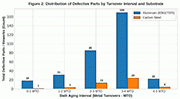
To establish empirical routing rules, production and quality logs were aggregated into discrete 1.0-MTO intervals across the 5-MTO lifecycle. Table 2 and Figure 2 summarize the total volume of reworked parts categorized by substrate type.
The data clearly demonstrate that the 3–4 MTO interval represents the single highest quality risk zone for the manufacturing plant, accounting for 52.0% of all aluminum reworks (169 of 325 parts) and 53.3% of all steel reworks (24 of 45 parts). The root-cause mechanism is directly tied to the fundamental chemistry of zincate activation on aluminum: zincate displacement immersion produces a fragile, nanometer-thin zinc film. In fresh baths (<escape><</escape>2 MTO), nickel deposition initiates within 10–15 seconds, dissolving and encapsulating the zinc layer cleanly. However, in aged baths (>3 MTO), the reduced catalytic deposition rate causes slow zinc dissolution without instantaneous nickel strike coverage, leading to microscopic interfacial voids, hydrogen blistering, and delamination (Sudagar et al., 2013; Stapleton, 1995).
4. Industrial Application: The Three-Zone Operational Strategy
Based on the empirical findings, the traditional "one-size-fits-all" bath disposal policy (e.g., arbitrarily dumping the bath at 4 or 5 MTOs regardless of workload) was replaced by a data-driven Three-Zone Dynamic Material Routing Strategy.
By establishing these explicit boundaries, the facility achieves two operational benefits: (1) eliminating up to 90% of high-cost aluminum blistering and delamination rejects by gating production prior to the fourth MTO, and (2) maximizing the total chemical asset value by extending bath utilization for steel parts through the fifth turnover, avoiding premature chemical dumping and minimizing hazardous waste treatment costs.
5. Roadmap to Predictive Quality 4.0 Modeling (Phase 2)
This descriptive baseline serves as the foundational data layer for Phase 2 of the industrial digital transformation. With verified historical data clean of anomalous noise, automated machine learning pipelines can be systematically trained. Future research will integrate automated SQL data pipelines from digital shop-floor travelers directly into multiple linear regression and gradient-boosted decision trees (XGBoost/Random Forest). This will enable real-time prediction of exact remaining bath life in operating hours and automated dynamic alerts prior to loading sensitive aerospace components.
Conclusions
1. Standard chemical control parameters are insufficient proxies for bath health: Active nickel concentration and pH remained strictly within statistical control limits (5.81 ± 0.14 g/L and 5.08 ± 0.09) throughout the bath life, masking the accumulation of deleterious orthophosphite by-products.
2. Bath aging exhibits a critical inflection point between 3.0 and 4.0 MTOs: More than 52% of all recorded surface defects were concentrated within the 3–4 turnover window, confirming that bath degradation is non-linear and accelerates sharply in mid-to-late life stages.
3. Substrate-specific behavior defines operational replacement criteria: Aluminum alloys (6061-T6, 7075-T6) displayed extreme sensitivity to bath aging, driving rework rates up to 7.8%, while carbon steel demonstrated significant chemical resilience, maintaining rework rates below 1.5% under identical conditions.
4. The Three-Zone Strategy provides immediate risk reduction and cost optimization: Gating aluminum processing at 4.0 MTOs and reserving late-stage chemistry exclusively for steel components prevents catastrophic aerospace scrap while extracting 100% of chemical asset life.
5. Descriptive baselines are mandatory prerequisites for AI/ML deployment: Establishing clear empirical rulesets from historical shop-floor records eliminates algorithmic bias and ensures future predictive models are grounded in physical metallurgical reality.
Eduardo Castillo Badial, Chem. Eng., MBA, M.Sc., CAF
Kion Tech Company
2190 Oakland Road, San Jose, CA 95131, USA
Tel. +1.408.435-3008
E-mail: qa@kiontech.com




 BACK